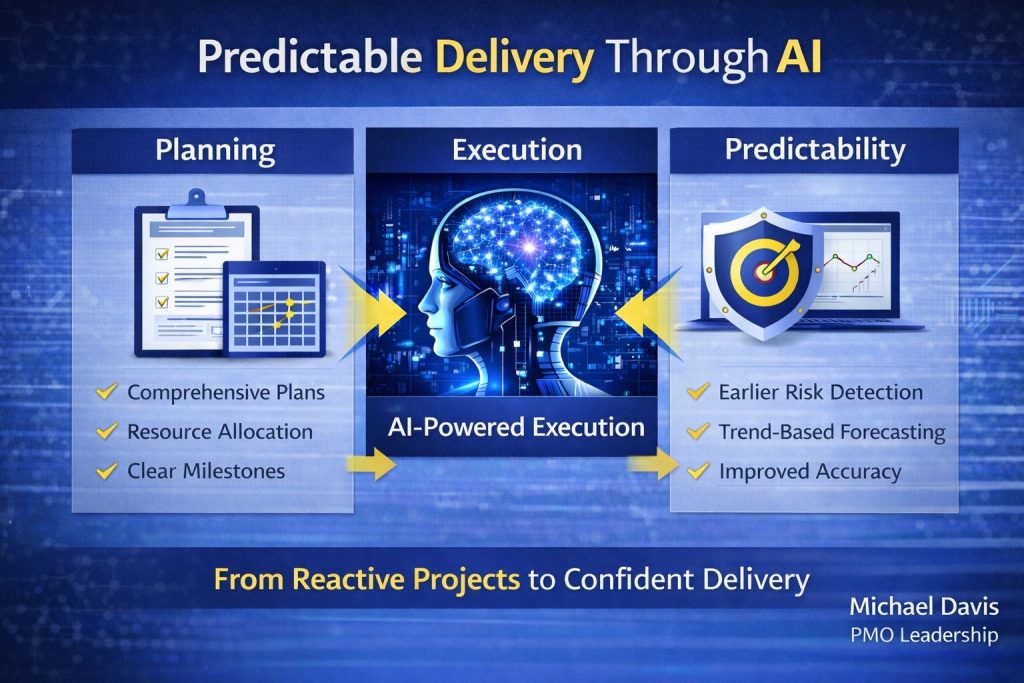
Delivery organizations run on people. Getting the right resources aligned to the right work at the right time is one of the most operationally demanding challenges a PMO faces.
Workforce planning typically involves:
- Resource allocation across active projects
- Utilization tracking by role and skill
- Capacity forecasting against pipeline demand
- Skill gap identification
- Hiring and staffing timing decisions
When workforce planning is reactive, organizations lose margin, miss delivery windows, and overextend their best people. This is where AI can shift the equation, but only when the data foundation is built correctly.
Where AI Improves Workforce Planning
Before AI can improve workforce planning, the data has to be trustworthy. That starts with finding a system and a dataset that every stakeholder can agree on. In practice, this means bringing the PMO and delivery directors together to align on a single source of truth, establishing the dataset with the right structure, and making that data available for AI consumption in a way that is clean, consistent, and governed.
Once that foundation is in place, AI can analyze demand signals across the delivery portfolio and connect them to available capacity in real time. It can also support active scenario discussions that help leaders think through decisions before making them.
AI can assist with:
- Modeling capacity demand against active and pipeline projects
- Identifying skill-specific bottlenecks before they impact delivery
- Forecasting utilization trends across teams and roles
- Highlighting misalignment between staffing levels and project timelines
- Simulating the impact of adding or reducing resources on a project or across the pool
- Modeling the downstream effects of moving work from one project to another
- Running close rate scenarios to show what pipeline changes do to capacity
This moves workforce planning from a reporting function to an active decision support function.
Workforce Planning With Confidence
Workforce planning is not just about filling open seats. It is about understanding where demand is heading and making staffing decisions ahead of the curve.
Equally important is how AI surfaces that information. Structure and guardrails within AI agents matter as much as the data itself. When those guardrails are in place, reporting is consistent, conversations are grounded in the same dataset, and leaders are not second-guessing the numbers before they can act on them.
What changes the dynamic even further is the ability to have real scenario conversations directly with the data. Leaders can explore questions like: what happens if we pull two resources off this project, what does utilization look like if we shift this workstream, or what is the capacity impact if we add headcount to the delivery pool? Those conversations used to take days of spreadsheet work. With a governed dataset and structured AI agents, they happen in the room.
When AI supports capacity insight with proper structure:
- Resource gaps are visible before they become delivery risks
- Utilization stays balanced across teams
- Hiring decisions are informed by delivery data
- Scenario options are explored and compared in real time
- Leaders can make staffing commitments with greater confidence
This is where workforce planning matures from reactive to predictive.
Better Workforce Planning Drives Faster Value
Strong workforce planning protects delivery timelines and margin. When resources are aligned early and leaders can model decisions before committing to them, projects start with momentum instead of scrambling for coverage.
When workforce planning improves:
- Projects launch with the right team in place
- Delivery timelines are more predictable
- Margin compression from emergency staffing is reduced
- Customer commitments are better protected
- Resource decisions are made with data, not instinct
Workforce planning is not an HR function. It is a delivery leadership function.
The Role of a Strong PMO
Strong PMOs do not just track who is assigned to what. They connect workforce data to portfolio demand and translate that insight into leadership decisions. A critical part of that role is building the data infrastructure that makes AI-supported planning possible, including aligning stakeholders on a shared system, governing the dataset, and ensuring AI outputs are structured for consistent, reliable reporting.
That infrastructure also enables something more powerful: the ability to run live scenario conversations with leadership. When the PMO owns the data and the AI layer is properly structured, those conversations shift from status updates to strategic decisions.
A mature PMO provides:
- A clear view of current and forecasted utilization
- Early signals when capacity is at risk
- Data to support staffing, hiring, and prioritization conversations
- Real-time scenario modeling to support faster decisions
- Alignment between sales commitments and delivery readiness
When the PMO owns workforce visibility and the data behind it, the organization can make faster and more confident resource decisions.
Practical Actions to Improve Workforce Planning Readiness
1. Align Stakeholders on a Single Data Source
The first step is agreement, not technology. Work with delivery directors and team leads to identify a system everyone can commit to as the source of truth for workforce data. Without that alignment, AI outputs will be questioned before they are used.
2. Establish and Govern the Dataset
Define the data structure before connecting it to any AI layer. Consistent fields, naming conventions, and update disciplines are what make the dataset reliable for AI consumption and for leadership decision-making.
3. Build Guardrails Into AI Agents
Structure within the AI layer is not optional. Define how agents should report, what language they should use, and what boundaries they operate within. This ensures reporting stays consistent and conversations stay grounded in the same data.
4. Enable Scenario Modeling as a Planning Tool
Structure the data and AI agents to support live scenario discussions. Leaders should be able to ask what happens if resources are added or reduced, if work is moved between projects, or if pipeline assumptions change, and get an informed answer without waiting days for analysis.
5. Track Utilization at the Skill Level, Not Just the Team Level
Aggregate utilization numbers hide the real bottlenecks. Knowing a team is at 85% capacity does not tell you which specific skills are constrained.
6. Establish a Capacity Review Cadence
Workforce planning is not a one-time exercise. Set a recurring review rhythm where delivery leaders, PMO, and resource managers align on capacity status and forward demand. Scenario modeling works best when it is part of a structured conversation, not a one-off exercise.
Final Thought
Workforce planning should not be reactive. It should be predictive and interactive.
Getting there requires more than AI tools. It requires stakeholder alignment on data, a governed dataset built for AI consumption, structured agents that report consistently, and the ability to explore decisions through real scenario conversations. When those elements are in place:
- Demand signals surface earlier
- Staffing decisions improve
- Scenario options are explored before commitments are made
- Delivery confidence increases
- Margin is better protected
How does your organization currently connect pipeline demand to workforce capacity?
If you have questions or would like to discuss this topic further, feel free to get in touch.