Delivery organizations manage more than individual projects. They manage portfolios, and the health of a portfolio determines whether the organization is delivering on its commitments or just staying busy.
Portfolio management typically involves:
- Prioritizing active and incoming work
- Tracking delivery health across multiple projects
- Aligning resources to strategic priorities
- Managing interdependencies between workstreams
- Providing executives with a clear view of risk, progress, and value
When portfolio visibility is weak, organizations make prioritization decisions on instinct, discover problems too late to course correct, and struggle to connect delivery performance to business outcomes. This is where AI can strengthen portfolio intelligence, but only when the underlying delivery data is structured and governed correctly.
Where AI Improves Portfolio Visibility
Portfolio intelligence starts with data quality. Before AI can surface meaningful portfolio insights, delivery data needs to be consistent across projects. That means aligning project teams on a shared structure, governing status and progress inputs, and ensuring the dataset reflects reality, not what teams believe leadership wants to see.
Once that foundation is in place, AI can aggregate delivery signals across the portfolio and surface patterns that are invisible in manual status reviews.
AI can assist with:
- Aggregating health signals across all active projects into a single portfolio view
- Identifying concentration risk where too many critical projects share the same resources
- Detecting early indicators of delivery stress before milestones are missed
- Modeling the downstream impact of prioritization changes across the portfolio
- Highlighting misalignment between strategic priorities and resource allocation
- Surfacing which projects are consuming capacity without delivering proportionate value
- Connecting portfolio demand to workforce availability in real time
This moves portfolio management from a reporting function to a strategic decision support capability.
Portfolio Management With Confidence
Portfolio management is not just about tracking what is in flight. It is about understanding whether the right work is being done at the right time with the right resources behind it.
The quality of AI-supported portfolio conversations depends heavily on how the AI layer is structured. Guardrails matter here just as much as they do in workforce planning. When AI agents are configured to report consistently, use the same data definitions, and operate within defined boundaries, portfolio conversations stay grounded and productive. Leaders stop debating the numbers and start making decisions from them.
What changes most significantly is the ability to explore portfolio decisions before committing to them. Questions like: what happens to delivery timelines if we accelerate this initiative, which projects are at risk if we reduce available capacity, or where are we carrying the most schedule risk right now? Those conversations no longer require days of offline analysis. When the data is governed and the AI layer is properly structured, they happen in real time.
When AI supports portfolio intelligence with proper structure:
- Delivery risk is visible before it escalates
- Prioritization conversations are grounded in data, not politics
- Resource alignment reflects strategic priorities rather than historical patterns
- Leaders can model trade-offs before making commitments
- Executive reporting reflects actual portfolio health, not filtered optimism
This is where portfolio management matures from status tracking to strategic oversight.
Better Portfolio Visibility Drives Faster Value
Strong portfolio management protects organizational capacity. When leaders can see where delivery risk is concentrating, where priorities are misaligned, and where resources are being consumed without producing value, they can redirect faster and with greater confidence.
When portfolio visibility improves:
- Strategic priorities stay funded and resourced
- Delivery risk surfaces before it becomes a headline
- Resource decisions reflect portfolio priorities rather than squeaky wheels
- Executive conversations shift from status to direction
- Organizations deliver more of what matters and less of what simply stayed on the list
Portfolio management is not a PMO administrative function. It is an executive decision-making function.
The Role of a Strong PMO
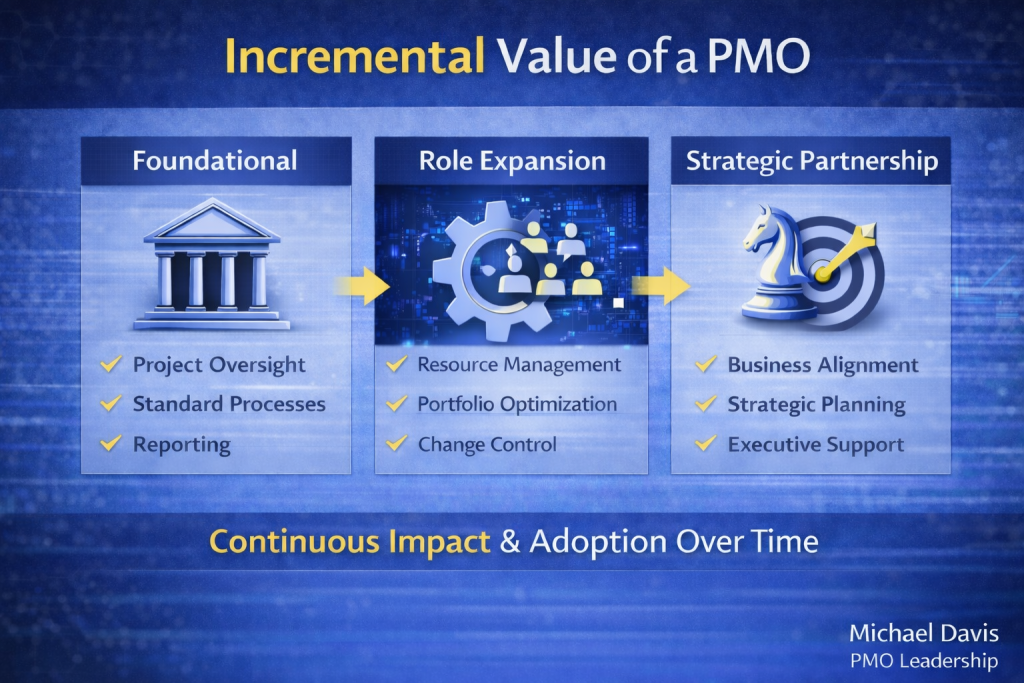
Strong PMOs do not just compile project status reports. They own the portfolio data layer and translate it into the insights executives need to lead. That includes building the data governance model, structuring the AI agents that process delivery signals, and ensuring portfolio outputs are consistent, trustworthy, and actionable.
A mature PMO also owns the scenario modeling capability at the portfolio level. When leadership asks what happens if priorities shift, which projects can absorb a resource reduction, or what the risk exposure looks like across the portfolio, the PMO should be able to answer those questions with data, not approximations.
A mature PMO provides:
- A governed portfolio data structure that supports AI-enabled analysis
- Consistent delivery health signals across all active projects
- Real-time scenario modeling to support prioritization decisions
- A clear view of where strategic initiatives are at risk
- Alignment between portfolio demand and available organizational capacity
When the PMO owns portfolio intelligence and the data infrastructure behind it, executives can lead with clarity instead of reacting to surprises.
Practical Actions to Improve Portfolio Management Readiness
1. Standardize Delivery Data Across Projects
AI-supported portfolio management only works when the underlying data is consistent. Align project teams on common status definitions, milestone formats, and progress reporting structures before expecting the AI layer to produce reliable insights.
2. Identify the Metrics That Matter at the Portfolio Level
Not every project metric belongs in an executive portfolio view. Define which signals matter most at the portfolio level: delivery health, resource concentration, schedule variance, strategic alignment, and value delivery. Build the data structure around those signals.
3. Build Guardrails Into Portfolio AI Agents
Just as with workforce planning, the AI layer needs structure. Define how portfolio agents should report, what escalation thresholds trigger alerts, and what language they should use when surfacing risk. Consistency in the output builds executive trust in the input.
4. Enable Portfolio Scenario Modeling
Structure the portfolio data and AI agents to support real-time scenario conversations. Leaders should be able to ask what happens if a priority shifts, a key resource is lost, or a major project is delayed, and get a meaningful answer without waiting for an offline analysis cycle.
5. Connect Portfolio Visibility to Workforce Data
Portfolio decisions and workforce decisions are not separate conversations. When the portfolio data layer connects to workforce capacity data, leaders can see the full impact of prioritization changes on both delivery timelines and team utilization simultaneously.
6. Establish a Portfolio Review Cadence
Portfolio intelligence is only valuable if it informs decisions at the right rhythm. Set a recurring executive portfolio review where delivery health, risk concentration, and prioritization alignment are reviewed together. AI-supported scenario modeling works best as part of a structured leadership conversation, not a one-time briefing.
Final Thought
Portfolio management should not be a lagging indicator of delivery problems. It should be a forward-looking capability that helps organizations make better decisions before those decisions become difficult.
Getting there requires more than dashboards. It requires consistent delivery data, governed AI agents that report reliably, and the ability to model portfolio decisions in real time. When those elements are in place:
- Delivery risk surfaces before it escalates
- Prioritization stays aligned to strategy
- Resource decisions reflect portfolio reality
- Executives lead with data instead of instinct
- Organizations deliver what matters, not just what is already in motion
How does your organization currently give executives visibility into portfolio health?
If you have questions or would like to discuss this topic further, feel free to get in touch.