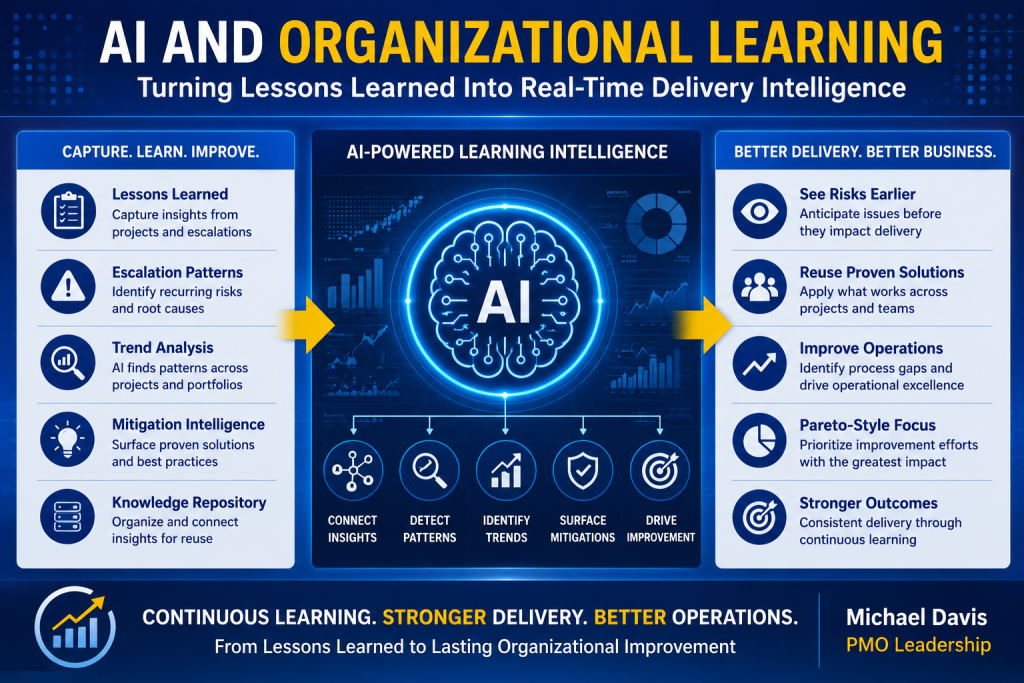
Most organizations capture lessons learned after a project is complete.
By then, the opportunity to prevent similar problems elsewhere may already be gone.
Lessons learned often become archived documentation instead of operational intelligence that actively improves delivery performance across the organization.
Lessons learned processes typically involve:
- Retrospective project reviews
- Escalation summaries
- Root cause discussions
- Process improvement recommendations
- Knowledge repository updates
However, in many organizations, those insights stay disconnected from active delivery operations.
This is where AI can transform organizational learning maturity.
Where AI Improves Organizational Learning
AI can analyze lessons learned, escalation patterns, delivery risks, mitigation actions, and operational outcomes across projects simultaneously.
Instead of storing knowledge statically, organizations can begin using lessons learned as active delivery intelligence while projects are still in motion.
AI can assist with:
- Identifying recurring delivery risks across projects
- Detecting repeating dependency failures and escalation patterns
- Surfacing mitigation strategies from similar historical situations
- Highlighting operational trends across teams and portfolios
- Connecting lessons learned directly into active delivery workflows
- Identifying process gaps contributing to repeated delivery issues
- Detecting concentration areas suitable for Pareto-style operational improvements
This transforms lessons learned from documentation into continuous operational intelligence.
Organizational Learning With Confidence
Lessons learned should not wait until project closure to provide value.
Strong delivery organizations continuously learn while execution is still happening.
When organizational learning improves:
- Repeating risks are identified earlier
- Mitigation strategies become reusable
- Operational weaknesses become visible
- Teams improve faster across the portfolio
- Delivery maturity accelerates
This is where organizations begin moving from reactive correction to proactive improvement.
Better Organizational Learning Drives Better Operations
The value of lessons learned is not the meeting itself.
The value is the ability to improve operational performance across the organization.
When organizational learning improves:
- Escalation patterns become easier to identify
- Teams avoid repeating the same delivery mistakes
- Process bottlenecks become more visible
- Operational inefficiencies surface earlier
- Continuous improvement efforts become data-driven
- Leadership can prioritize improvement initiatives more effectively
This also creates the ability to identify trending operational issues and focus improvement efforts using Pareto-style analysis.
Organizations can begin identifying:
- The most common delivery disruption sources
- The operational gaps creating the largest delivery impact
- The recurring escalation categories consuming leadership attention
- The process weaknesses contributing to repeated delays or rework
Lessons learned should improve more than project delivery.
They should improve the organization itself.
The Role of a Strong PMO
Strong PMOs do not just archive lessons learned.
They operationalize them.
This requires:
- Governed lessons learned structures
- Consistent categorization and tagging
- Escalation trend analysis
- Cross-project operational visibility
- AI-enabled learning and mitigation intelligence
When AI supports organizational learning:
- Delivery risks become easier to recognize earlier
- Mitigation guidance becomes reusable across projects
- Operational trends become more visible
- Leadership gains better improvement insight
- Continuous improvement becomes measurable
A mature PMO helps the organization learn continuously instead of repeatedly solving the same problems.
Practical Actions to Improve Organizational Learning Readiness
1. Capture Lessons Learned Continuously
Do not wait until project closure. Capture risks, mitigation actions, escalation outcomes, and operational observations throughout delivery.
2. Standardize Lessons Learned Categories
Consistent categorization allows AI to identify trends, recurring issues, and operational concentration areas more effectively.
3. Connect Lessons Learned to Active Projects
Lessons learned should influence in-flight delivery decisions, not just future projects. AI can help surface relevant historical insights during active execution.
4. Analyze Escalation Patterns Across the Portfolio
Escalations often reveal systemic operational weaknesses. Trend analysis helps organizations identify recurring pressure points earlier.
5. Use Pareto Analysis to Prioritize Improvements
Not all problems create equal operational impact. Focus improvement efforts on the recurring issues creating the greatest delivery disruption.
6. Continuously Refine Mitigation Guidance
As delivery teams identify successful mitigation strategies, feed those outcomes back into the organizational learning process so future projects benefit from proven approaches.
Final Thought
Lessons learned should not become forgotten documentation.
They should become operational intelligence that continuously strengthens delivery performance across the enterprise.
When AI supports organizational learning:
- Risks surface earlier
- Mitigation strategies improve
- Escalation trends become visible
- Operational maturity accelerates
- Delivery organizations improve continuously
The organizations that learn fastest often deliver the most consistently.
How does your organization currently operationalize lessons learned across active delivery efforts?
If you have questions or would like to discuss this topic further, feel free to get in touch.