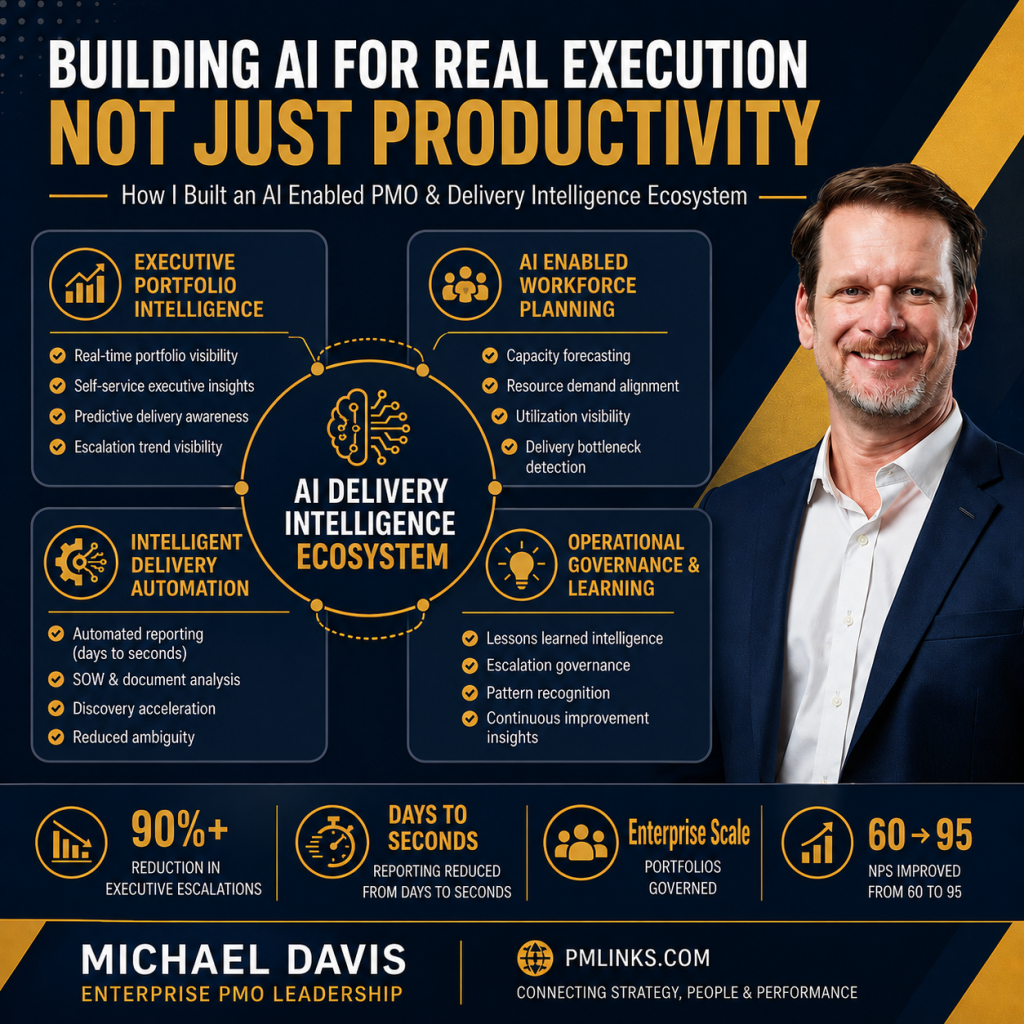
Most organizations experimenting with AI are still focused on individual productivity.
Meeting summaries. Chat prompts. Content generation. Faster note taking.
While those capabilities can be useful, they rarely solve the larger operational problems organizations struggle with every day.
The real opportunity with AI is not just helping individuals work faster. It is helping organizations execute better.
That is the direction I focused on building.
Moving Beyond AI Productivity Tools
The goal was never to simply add AI into project management workflows for the sake of innovation.
The goal was to create an operational ecosystem that improved:
- Executive visibility
- Delivery predictability
- Workforce planning
- Governance
- Escalation management
- Organizational learning
- Decision support
Instead of isolated tools, the focus became building connected intelligence across delivery operations.
This is where AI begins to move from experimentation into operational transformation.
What the Ecosystem Was Designed to Solve
Most delivery organizations struggle with common execution problems:
- Leadership lacks real-time visibility into delivery health
- Reporting consumes large amounts of manual effort
- Escalations surface too late
- Resource planning is reactive instead of proactive
- Lessons learned are captured but rarely operationalized
- Teams operate across disconnected systems and workflows
The AI ecosystem was designed to reduce those gaps by creating centralized operational intelligence that leadership and delivery teams could actually use.
Core Areas of the AI Delivery Intelligence Ecosystem
Executive Portfolio Intelligence
The ecosystem provided real-time portfolio visibility and executive self-service insights designed to reduce dependency on manually prepared reporting.
This included:
- Portfolio health visibility
- Predictive delivery awareness
- Escalation trend monitoring
- Centralized operational insights
The objective was to give leadership faster access to meaningful information that supported decision making.
AI Enabled Workforce Planning
Resource management is often one of the largest pain points in growing delivery organizations.
The ecosystem introduced:
- Capacity forecasting
- Demand alignment visibility
- Utilization awareness
- Delivery bottleneck identification
This created a stronger operational understanding of where teams were overextended, underutilized, or approaching delivery risk.
Intelligent Delivery Automation
A major focus was reducing manual operational overhead.
Automation capabilities included:
- Reporting acceleration
- AI-assisted document and SOW analysis
- Discovery support
- Reduced ambiguity in delivery preparation
The result was less time spent manually assembling information and more time focused on execution and decision making.
Operational Governance and Organizational Learning
One of the most overlooked opportunities with AI is organizational learning.
The ecosystem incorporated:
- Lessons learned intelligence
- Escalation governance
- Pattern recognition
- Continuous improvement insights
This helped operational knowledge become reusable instead of isolated within individual teams or projects.
The Business Impact
The operational improvements produced measurable outcomes, including:
- Reporting reduced from days to seconds
- Significant reduction in executive escalations
- Improved visibility into delivery performance
- Stronger operational alignment across teams
- Increased delivery predictability
- Improved customer experience and satisfaction
Most importantly, the ecosystem helped shift delivery organizations from reactive management toward proactive operational awareness.
AI Should Strengthen Execution, Not Replace Leadership
One of the biggest misconceptions around AI is that it replaces operational leadership.
In reality, AI becomes most valuable when it strengthens:
- Visibility
- Decision making
- Organizational alignment
- Governance
- Operational awareness
Technology alone does not fix execution.
Strong leadership, structure, culture, and operational clarity still matter.
AI simply becomes a force multiplier when those elements are aligned correctly.
Final Thoughts
AI has the potential to fundamentally improve how organizations execute.
But meaningful transformation does not come from isolated productivity tools alone.
It comes from building operational ecosystems that connect people, delivery, governance, intelligence, and decision making together in ways that improve how the organization functions as a whole.
That is where I believe the real value of AI in delivery leadership exists.
If you are looking for an Enterprise PMO, delivery transformation, or executive operating partner who leads with culture and delivers with results, let’s connect on PMLinks.com or on LinkedIn at linkedin.com/in/pmlinks.