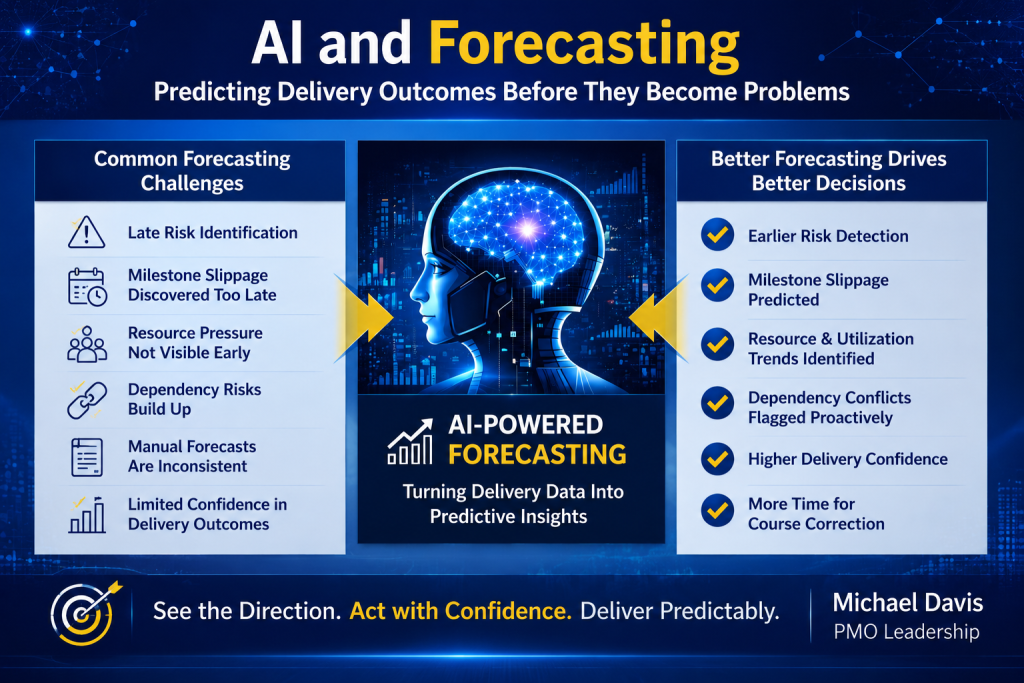
Most organizations do not struggle because problems happen. They struggle because problems are identified too late to correct them without impact.
Forecasting is supposed to help leadership see delivery direction before issues become outcomes.
Forecasting typically involves:
- Delivery timeline projections
- Resource utilization trends
- Milestone confidence assessments
- Risk and dependency analysis
- Budget and margin visibility
However, forecasting is often reactive, manually assembled, and heavily dependent on individual interpretation. By the time reporting identifies a concern, delivery impact has often already begun.
This is where AI can improve forecasting maturity.
Where AI Improves Forecasting Visibility
AI can analyze delivery signals across schedules, milestones, resources, dependencies, risks, and project activity trends simultaneously.
Instead of reviewing isolated data points, AI can evaluate patterns and directional movement across the delivery environment.
AI can assist with:
- Identifying delivery trend deterioration early
- Forecasting milestone slippage probability
- Detecting utilization pressure before delivery impact occurs
- Highlighting dependency accumulation risk
- Identifying inconsistent execution patterns across projects
- Modeling delivery confidence against current trajectory
This shifts forecasting from static reporting to active delivery intelligence.
Forecasting With Confidence
Forecasting is not about predicting the future perfectly.
It is about identifying directional risk early enough to influence decisions.
When forecasting visibility improves:
- Risks surface earlier
- Leadership gains decision time
- Teams can course correct sooner
- Delivery confidence improves
Strong forecasting helps organizations act while options still exist.
This is where predictive delivery maturity begins to emerge.
Better Forecasting Drives Better Decisions
The value of forecasting is not the report itself. The value is the ability to make better decisions sooner.
When forecasting improves:
- Delivery risk becomes more visible
- Staffing adjustments happen earlier
- Dependency conflicts are addressed proactively
- Leadership can prioritize with greater confidence
- Customer commitments become more realistic
Forecasting is not just a PMO reporting exercise.
It is a leadership decision support capability.
The Role of a Strong PMO
Strong PMOs do not just report delivery performance. They provide visibility into delivery direction.
This requires structured delivery data, consistent governance, and clearly defined forecasting models that AI can interpret reliably.
When AI supports forecasting:
- Delivery trends become easier to identify
- Leadership sees directional movement earlier
- Resource pressure becomes visible before escalation
- Portfolio forecasting becomes more reliable
- Delivery confidence improves across the organization
A mature PMO helps leadership understand not only where projects are today, but where they are likely heading.
Practical Actions to Improve Forecasting Readiness
1. Standardize Delivery Data Structures
Forecasting accuracy depends on consistent project data. Milestones, risks, dependencies, and status indicators must follow standardized structures before AI can reliably interpret trends.
2. Focus on Trends Instead of Snapshots
Single status updates rarely tell the full story. Forecasting improves when organizations analyze movement over time rather than isolated reporting points.
3. Connect Resource Data to Delivery Forecasts
Delivery forecasting without workforce visibility creates blind spots. Resource pressure and utilization trends must be connected to forecasting models.
4. Define Forecast Escalation Thresholds
Organizations should clearly define what conditions trigger forecasting concern, leadership review, or proactive intervention.
5. Use Forecasting to Support Decisions, Not Just Reporting
Forecasting should influence prioritization, staffing, sequencing, and customer communication before delivery impact occurs.
6. Continuously Refine Forecast Models
Forecasting improves when PMOs review prediction accuracy over time and refine the underlying logic, thresholds, and assumptions.
Final Thought
Forecasting should not begin after delivery problems appear.
It should help organizations identify direction before issues become outcomes.
When AI supports forecasting:
- Delivery trends surface earlier
- Leadership gains more decision time
- Course correction becomes proactive
- Delivery confidence improves
- Time to value accelerates
How does your organization currently forecast delivery risk and project direction?
If you have questions or would like to discuss this topic further, feel free to get in touch.