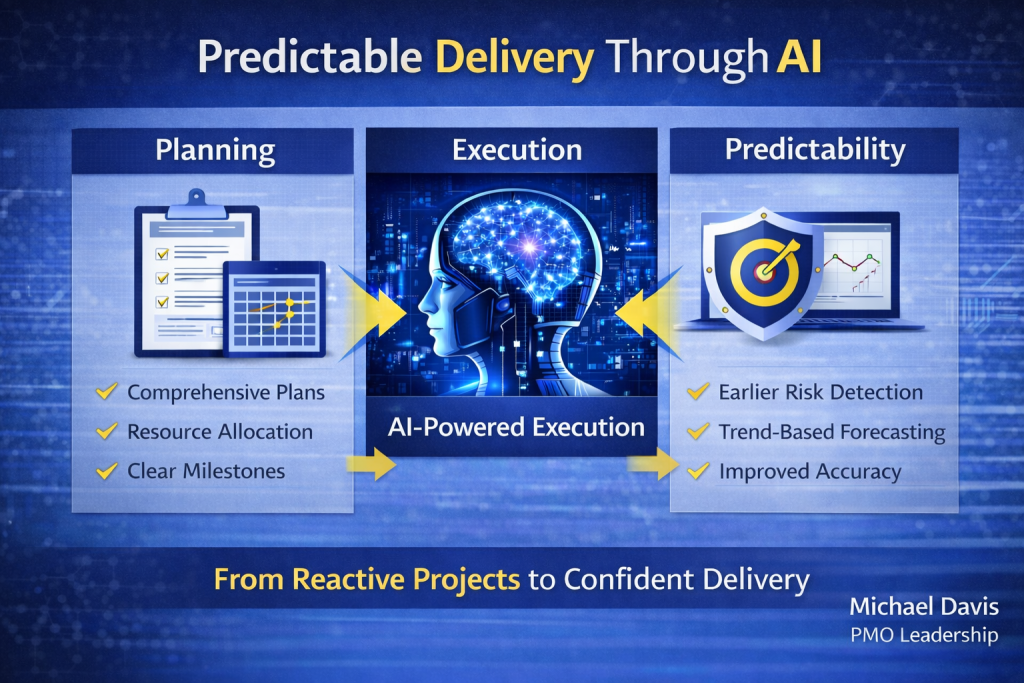
Status reporting is one of the most time-consuming activities in project delivery. Project managers, program managers, and PMO leaders spend hours every week gathering inputs, interpreting data, and crafting updates that are often outdated before they reach the people who need them.
Status reporting typically involves:
- Collecting updates from team members and workstream leads
- Interpreting delivery progress against milestones and baselines
- Assessing risk and issue severity
- Summarizing findings for multiple audience levels
- Repeating the process again next week
The overhead is real, and the output often delivers less value than the effort invested. Generic status colors and templated commentary tell leadership that work is happening but rarely tell them what they need to know to act, redirect, or decide. This is where AI can make status reporting smarter, faster, and far more useful.
Where AI Improves Project and Activity Status
Smart status reporting starts with structured delivery data. When project and activity data is consistent, governed, and connected, AI can analyze delivery signals across tasks, milestones, risks, and resource inputs and generate status outputs that are meaningful rather than mechanical.
AI can assist with:
- Generating narrative status summaries from structured project data
- Identifying which activities are trending toward delay before they miss a deadline
- Surfacing risk and issue patterns across multiple workstreams simultaneously
- Differentiating between noise and signals that actually require leadership attention
- Producing tiered status outputs tailored to the audience, from team level to executive level
- Highlighting where dependencies between activities or projects are creating delivery pressure
- Flagging when progress has stalled and course correction involvement is warranted
This moves status reporting from a documentation exercise to a delivery intelligence function.
Status Reporting With Confidence
Smart status is not about eliminating the project manager from the reporting process. It is about removing the manual burden that consumes their time and replacing it with a more accurate, more consistent, and more actionable output.
When AI agents are structured with proper guardrails and connected to governed project data, they produce status outputs that reflect actual delivery health rather than filtered interpretations. The language stays consistent. The thresholds for escalation stay defined. Leadership sees what is actually happening rather than what the team chose to surface.
What changes most significantly is the quality of the conversation that status enables. When a program manager walks into a leadership review with AI-generated insights already identifying where attention is needed, the meeting stops being a status briefing and becomes a decision conversation. That shift matters at every level of the organization.
When AI supports smart project status:
- PMs spend less time compiling and more time managing
- Status reflects delivery reality, not reporting interpretation
- Leadership receives tiered insights calibrated to their role
- Escalation triggers are defined and consistent, not subjective
- Course correction happens earlier because problems surface sooner
Better Status Drives Faster Course Correction
The real cost of poor status reporting is not the time it takes to produce it. It is the decisions that get delayed or made without the right information. When status is generic, leadership cannot distinguish between a project that is genuinely healthy and one that is quietly accumulating risk.
Smart AI-supported status closes that gap. It gives leaders the signal they need at the right moment, framed at the right level of detail, with enough context to act rather than simply acknowledge.
When status reporting improves:
- At-risk activities surface before they become missed milestones
- Program managers can focus their attention on the workstreams that actually need it
- Leaders at every level get updates calibrated to what they need to know
- Escalation requests are grounded in data, not urgency or perception
- Organizations spend less time chasing status and more time delivering
The Role of a Strong PMO
Strong PMOs do not just enforce status reporting standards. They own the data structure and governance that makes smart status possible. That means defining what consistent project and activity data looks like, setting the rules for how AI agents interpret and report delivery signals, and establishing the escalation logic that determines when leadership involvement is warranted.
A mature PMO also owns the status tiering model. Executive status looks different from program-level status, which looks different from team-level status. AI can produce all three from the same underlying data if the structure is in place to support it. Without that structure, you get the same generic update pushed to every audience regardless of what they actually need.
A mature PMO provides:
- A governed data structure that supports AI-generated status outputs
- Consistent escalation thresholds applied across all active projects
- Tiered status frameworks calibrated to team, program, and executive audiences
- AI agent guardrails that produce reliable, consistent reporting language
- A clear mechanism for course correction requests to reach leadership with context attached
When the PMO owns the status intelligence layer, project and program managers operate more effectively and leadership makes better decisions faster.
Practical Actions to Improve Status Reporting Readiness
1. Standardize the Data Behind the Status
AI-generated status is only as good as the data feeding it. Define what completion means, how milestones are tracked, how risks are logged, and how dependencies are documented. Consistent inputs produce consistent and trustworthy outputs.
2. Define Escalation Thresholds Before They Are Needed
Decide in advance what triggers a status change, what warrants a course correction flag, and what requires direct leadership involvement. AI agents enforce these thresholds consistently when they are clearly defined. Without that definition, AI will guess and so will everyone else.
3. Build Status Outputs for Multiple Audiences
A team lead and a VP need different information from the same project. Structure AI outputs to serve each audience level without requiring manual reformatting. One data source, tiered outputs based on role and decision need.
4. Use Smart Status to Drive the Meeting Agenda, Not Replace It
AI-generated status should walk into the review meeting with leadership before the conversation starts. That means the meeting opens with insights already identified, priorities already surfaced, and course correction requests already framed. Leaders can ask better questions when they are not hearing about a problem for the first time.
5. Connect Activity Status to Portfolio Health
Individual project status does not live in isolation. When activity and project status feeds into portfolio-level visibility, leaders can see concentration risk, dependency pressure, and delivery health across the full portfolio rather than one project at a time. AI makes that connection possible when the data layer is governed consistently.
6. Review and Refine AI Status Outputs Regularly
Smart status improves over time when project managers and PMO leaders actively review outputs, correct misclassifications, and refine the logic behind escalation flags. Treat AI status agents as a capability that matures with the delivery environment, not a set-it-and-forget-it tool.
Final Thought
Status reporting should serve delivery, not consume it. When project managers spend most of their reporting cycle gathering and formatting information, the organization is investing heavily in a process that produces limited decision value.
AI-supported smart status shifts that investment. The data does the heavy lifting. The project manager stays focused on delivery. Leadership gets the insight they need at the right level of detail and at the right moment to act.
When smart status reporting is in place:
- PMs lead projects instead of documenting them
- Program managers see across workstreams with clarity
- Leaders receive signals, not summaries
- Course corrections happen before consequences do
- Delivery organizations move faster because the right people know the right things at the right time
How does your organization currently decide what to escalate, and how confident are you that leadership is seeing the full picture?
If you have questions or would like to discuss this topic further, feel free to get in touch.