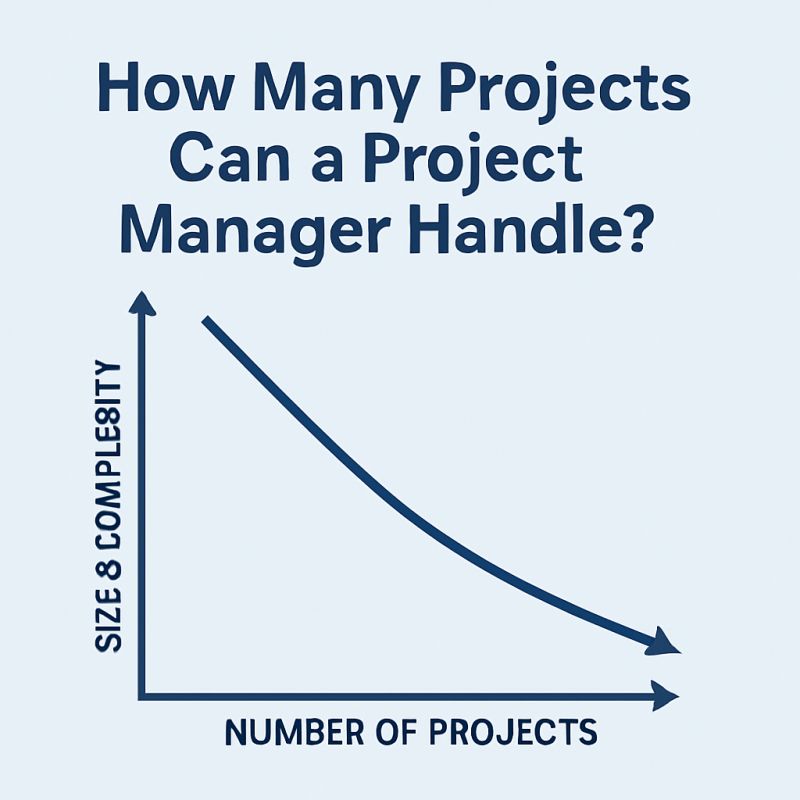
It is a common question, but the real answer is not a simple number.
The better question is this:
How many projects can a project manager handle effectively without increasing delivery risk, losing visibility, or weakening execution?
Some organizations expect one project manager to handle only a few strategic initiatives. Others assign many active efforts at the same time and assume that is normal. The right answer depends on far more than just project count.
Project manager capacity is shaped by complexity, team maturity, organizational structure, stakeholder expectations, governance demands, and the amount of coordination required to move work forward successfully.
A project manager is not just tracking tasks. A strong project manager is driving clarity, alignment, communication, risk visibility, and execution discipline across the work.
That means capacity should be evaluated based on delivery conditions, not just the number of projects assigned.
What Influences Project Manager Capacity?
There is no universal project count that works in every environment. Capacity depends on several important factors.
1. Project Complexity
A project manager handling one large enterprise initiative with multiple workstreams, executive stakeholders, dependencies, and customer visibility may have a heavier load than someone coordinating several smaller efforts.
Complexity can include:
- cross functional dependencies
- multiple business owners
- technical uncertainty
- significant risk exposure
- customer or executive visibility
- regulatory or compliance demands
The more complexity involved, the more coordination and leadership attention the project requires.
2. Team Maturity
A strong, experienced, and self directed team usually requires less day to day project management effort than a team that needs more structure, follow up, and issue escalation.
When teams are highly mature:
- communication is often more consistent
- ownership is clearer
- risks are surfaced earlier
- decisions happen faster
When teams are less mature, the project manager often has to spend more time creating alignment, driving follow up, and keeping execution from drifting.
3. Organizational Environment
Some organizations operate with relatively stable priorities and clear governance. Others deal with constant interruptions, shifting direction, unclear ownership, and reactive decision making.
That matters.
A project manager working in a noisy environment may spend far more time on:
- reprioritization
- stakeholder communication
- escalation management
- expectation resets
- keeping work aligned through change
In those environments, capacity is consumed faster even if the official project count does not look high.
4. Governance and Administrative Load
Project management work is not limited to delivery coordination. Some roles also carry a heavy governance and reporting burden.
That may include:
- executive reporting
- steering committee preparation
- financial tracking
- status reporting
- meeting facilitation
- documentation expectations
- compliance related activities
If those responsibilities are significant, they reduce the amount of project volume that can be handled effectively.
Warning Signs a Project Manager Has Too Much Assigned
Organizations often realize a project manager is overloaded only after delivery problems have already started to show up.
Common signs include:
- delayed or inconsistent status updates
- increased reactive issue management
- missed follow ups
- overlooked dependencies
- communication gaps across teams
- rising stakeholder frustration
- weaker risk visibility
- more frequent schedule slippage
- constant context switching with little real progress
When those patterns appear, the problem is not always the project manager. In many cases, it is a workload and environment issue that has gone unaddressed.
Practical Actions to Assess Project Manager Capacity More Effectively
Here are simple ways organizations can make better decisions about project manager workload:
1. Evaluate Complexity, Not Just Project Count
Do not assign work based only on the number of projects. Look at stakeholder volume, dependency load, business impact, delivery risk, and coordination effort before deciding what one project manager can realistically handle.
2. Consider Team and Organizational Maturity
A strong, experienced team in a stable environment usually requires less hands on coordination than a less mature team working in a changing or unclear environment. Capacity should reflect that difference.
3. Account for Governance and Administrative Load
Some project managers spend significant time on executive reporting, financial tracking, compliance, steering meetings, and documentation. That effort should be included when evaluating workload, not treated as invisible overhead.
4. Watch for Early Signs of Overload
Do not wait for failure before adjusting assignments. Delayed updates, reactive issue handling, missed deadlines, and communication gaps are often signs that the project manager is carrying too much. Those signals should trigger review.
5. Rebalance Work Based on Delivery Reality
Capacity should be reviewed as projects evolve. A project manager who starts with a manageable portfolio may become overloaded as complexity, risk, or stakeholder demands increase. Rebalancing should be normal, not a last resort.
6. Treat PM Capacity as a Leadership Decision
Project manager workload affects delivery predictability, stakeholder alignment, and risk exposure. It should be treated as an operational and leadership decision, not just a staffing convenience.
Final Thought
There is no magic number that defines how many projects a project manager can handle well.
The better answer depends on complexity, team maturity, organizational conditions, governance expectations, and the level of coordination needed for successful delivery.
When organizations treat project manager capacity as a real leadership and delivery decision:
- execution improves
- risk becomes more visible
- communication gets stronger
- predictability increases
The question is not how many projects can be assigned.
The real question is whether the project manager has the capacity to lead them effectively.
If you have questions or would like to discuss this topic further, feel free to get in touch.