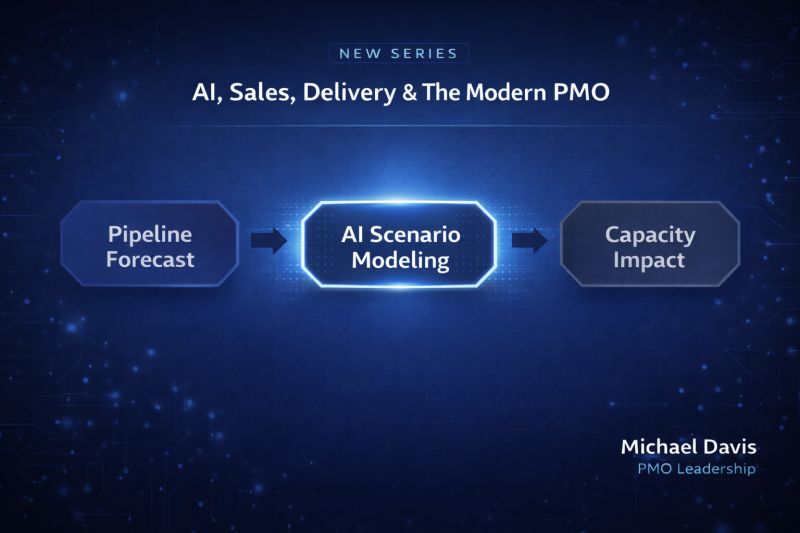
Most organizations forecast revenue, but far fewer forecast delivery impact. Sales pipelines are probability weighted. Workforce capacity is finite.
When multiple late-stage deals close in the same quarter, reality shows up quickly.
The pipeline may look healthy and revenue projections promising, but without modeling delivery implications, organizations often find themselves unprepared.
Pipeline is not capacity.
The Disconnect Between Sales and Delivery
This disconnect is common in delivery organizations. Sales forecasts focus on revenue, while delivery teams must manage real people, skills, and timelines.
Without alignment, organizations face:
- Resource constraints
- Delivery delays
- Margin compression
- Team burnout
- Reduced customer satisfaction
These challenges often appear only after deals are signed.
Where AI Adds Value
AI can move organizations beyond traditional reporting and into delivery readiness intelligence.
AI can help:
- Model scenarios where a percentage of late-stage deals close
- Identify which skills become constrained first
- Surface margin compression risk before staffing begins
- Highlight where forecasted demand exceeds delivery capability
- Simulate multiple close rate scenarios for executive planning
These insights help leadership prepare before commitments become reality.
Shifting the Role of the PMO
This approach shifts the PMO from tracking utilization after the fact to modeling organizational readiness in advance.
Strong PMOs help leadership:
- Understand capacity constraints early
- Evaluate delivery risk before deals close
- Align workforce planning with revenue forecasts
- Make informed tradeoff decisions
This moves the PMO from reporting to strategic planning.
Practical Questions to Consider
Consider your current approach:
- If multiple deals closed tomorrow, what would be impacted first?
- Which skills would become constrained?
- Where would delivery risk increase?
- Would margins be affected?
These questions highlight the value of delivery readiness planning.
Practical Actions to Improve Pipeline to Capacity Planning
Here are simple ways to better connect sales forecasts to delivery readiness:
1. Define Which Pipeline Stages Matter for Capacity Planning
Not every opportunity should influence workforce planning the same way. Establish clear rules for when pipeline activity should begin shaping capacity discussions.
2. Identify the Skills Most Likely to Constrain First
Map late stage opportunities against the roles and specialized skills most likely to be needed. This helps leadership see where pressure will build before deals close.
3. Use AI to Model Delivery Impact Scenarios
Leverage AI to simulate different close rate outcomes and show how timing, staffing demand, margin exposure, and utilization would shift under each scenario.
4. Review Pipeline and Capacity Together
Do not review sales forecasts in one conversation and delivery readiness in another. Bring the two together so leadership can make better tradeoff decisions earlier.
5. Create Response Plans Before Capacity Breaks
When likely constraints are identified, decide in advance what actions are available, such as hiring, contractor support, schedule adjustment, reprioritization, or deal timing discussions.
Final Thought
Pipeline growth is positive, but without capacity alignment, it can create delivery risk.
When organizations connect pipeline insight with workforce planning:
- Delivery readiness improves
- Risks are identified earlier
- Workforce planning becomes proactive
- Customer outcomes improve
If your sales forecast doubled tomorrow, would your organization know exactly what breaks first?
If you have questions or would like to discuss this topic further, feel free to get in touch.