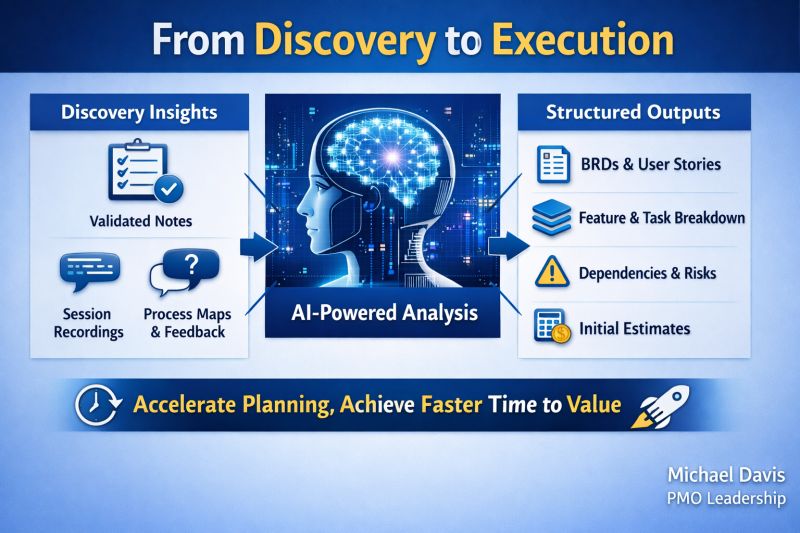
Discovery sessions generate valuable insights. However, too often that information remains buried in notes, recordings, and scattered documents. This is where delivery momentum can stall.
Teams complete discovery, but then spend time manually translating outcomes into requirements, backlog items, and delivery plans. This gap between discovery and execution slows progress and delays value.
Where AI Bridges Discovery to Execution
AI can help close the gap between discovery and delivery planning. By analyzing validated discovery content, AI can help create structured delivery artifacts such as:
- Draft BRDs or requirement summaries
- Initial user stories and backlog items
- Feature groupings and capability alignment
- Dependency identification across workstreams
- Early estimation support inputs
This allows teams to move from conversation to execution more efficiently.
Planning and Discovery Can Move in Parallel
The goal is not to finalize everything before planning begins. The goal is to accelerate structured planning as discovery evolves.
With AI support, teams can begin building:
- Work Breakdown Structure components
- Sprint backlogs
- Resource planning
- Delivery sequencing
This allows planning and discovery to progress in parallel instead of sequentially.
Faster Alignment and Time to Value
When discovery and planning move together:
- Delivery starts sooner
- Alignment improves
- Risks are identified earlier
- Time to value accelerates
This reduces delays and strengthens execution.
Strong PMOs Treat Discovery as a Clarity Engine
Strong PMOs do not treat discovery as a gate. They treat discovery as a continuous clarity engine that strengthens delivery planning over time.
When AI supports discovery execution:
- Planning accelerates
- Structure improves
- Teams align faster
- Delivery outcomes improve
Practical Actions to Turn Discovery into Execution
Here are simple ways to make discovery more actionable:
1. Standardize Discovery Outputs
Ensure discovery sessions consistently capture:
- business goals
- scope boundaries
- key stakeholders
- major requirements
- dependencies and constraints
Structured inputs make it easier to translate discussion into delivery artifacts.
2. Validate Before AI Processing
AI is most useful when working from validated notes, recordings, or summaries. Review discovery outputs first so the generated artifacts are based on accurate information.
3. Use AI to Draft Execution Artifacts
Leverage AI to turn discovery inputs into:
- requirement summaries
- initial user stories
- backlog items
- feature groupings
- dependency lists
This helps teams move faster without starting from a blank page.
4. Let Planning Start Earlier
Do not wait for discovery to be completely finished before planning begins. Use AI generated outputs to begin sequencing work, aligning resources, and shaping delivery plans while discovery continues.
5. Review and Refine with Delivery Leads
AI should accelerate preparation, not replace team judgment. Have project managers, product owners, architects, or delivery leaders refine the outputs before execution begins.
Final Thought
Discovery is only valuable if it drives execution.
When AI helps translate discovery into delivery planning:
- Momentum improves
- Alignment strengthens
- Planning accelerates
- Time to value improves
How does your team transition from discovery into delivery planning today?
If you have questions or would like to discuss this topic further, feel free to get in touch.