Why undefined role value turns a PMO into a staffing pool
A coordinator gets handed a multi quarter enterprise program because they had open capacity that week.
A senior project manager spends the same month updating a schedule nobody reads.
Both assignments were made by availability. Neither was made by value.
This failure does not show up as a missed milestone or a blown budget. It shows up slowly, as a growing inability to explain why the PMO costs what it costs. And it ends with a function that leadership treats as a queue rather than a capability.
The Org Chart Is Not a Value Model
Most PMOs have a staffing structure. Coordinator, project manager, senior project manager, business analyst, scrum master, delivery lead. The titles are on the org chart. The pay bands are in the HR system. The seats are funded.
What almost none of them have is a documented statement of what each of those seats produces that the others cannot.
Titles imply a hierarchy. They do not define an output. When output is undefined, the organization falls back on the only distinction it can actually observe, which is cost. A senior project manager becomes an expensive project manager. A coordinator becomes a cheap one. Every conversation about the PMO reduces to headcount and rate, because nothing in the reporting gives leadership anything else to work with.
That is not a finance problem. It is a design problem, created the moment roles were funded before value was defined.
Work Gets Assigned by Who Is Open
Assignment becomes a scheduling exercise. Someone looks at capacity, finds a name with room, and the engagement gets a resource. Complexity never enters the decision. Risk profile never enters the decision. Client sophistication never enters the decision.
The result is predictable. The hardest programs land wherever there was room that week, and the organization discovers the mismatch three months in, at the point where recovery costs the most.
One Yardstick Cannot Measure Five Different Seats
On time. On budget. Scope delivered. Those measures apply to everyone in the function, which means the reporting cannot distinguish one seat from another.
When a senior seat and a junior seat produce identical looking status reports, the cost difference between them becomes indefensible. Not because the difference is not real, but because nothing in the operating model was built to demonstrate it. The first time budget pressure arrives, the expensive seats get questioned first, and the PMO leader has no data to defend them with.
The same gap distorts advancement. If nobody has defined what a PM2 does that a PM1 does not, promotion turns into tenure. People move up because they have been there long enough, not because they demonstrated a capability the next seat requires. That damages the strongest performers most, and the ones with the most options leave first.
Then the Flattening Climbs
This is the part that gets missed, and it is the most damaging version of the problem.
Once the individual contributor roles have collapsed into one undifferentiated pool, leadership starts looking at the top of the function the same way. The PMO leader gets a utilization target. The title becomes player coach. The expectation becomes billable delivery with governance handled on the margins.
Portfolio visibility, escalation ownership, capability development, financial discipline, and executive decision support all become things that happen after hours, if they happen at all. The one seat that existed to protect the value of every other seat gets converted into capacity.
An organization that does this has not saved money. It has removed the only role positioned to prove the PMO was worth funding in the first place.
Start With the Work, Not the People
Before you can match a seat to an engagement, you need an objective read on what the engagement actually demands.
At one organization I led, I built a complexity scoring model that evaluated every incoming engagement across four dimensions: cost, timing, total revenue, and resource requirements, with a tiebreaker mechanism to resolve edge cases and produce a definitive rating. The output determined governance depth, documentation requirements, and oversight level for that engagement.
It also determined which seat belonged on it.
That last part matters. Complexity scoring is usually framed as a governance tool. It is equally a staffing tool. Once the work can be rated objectively, assignment stops being a capacity conversation and becomes a fit conversation.
Define Output Per Seat, Not Tasks Per Seat
A task list describes activity. A value statement describes what the organization gets that it would not otherwise have.
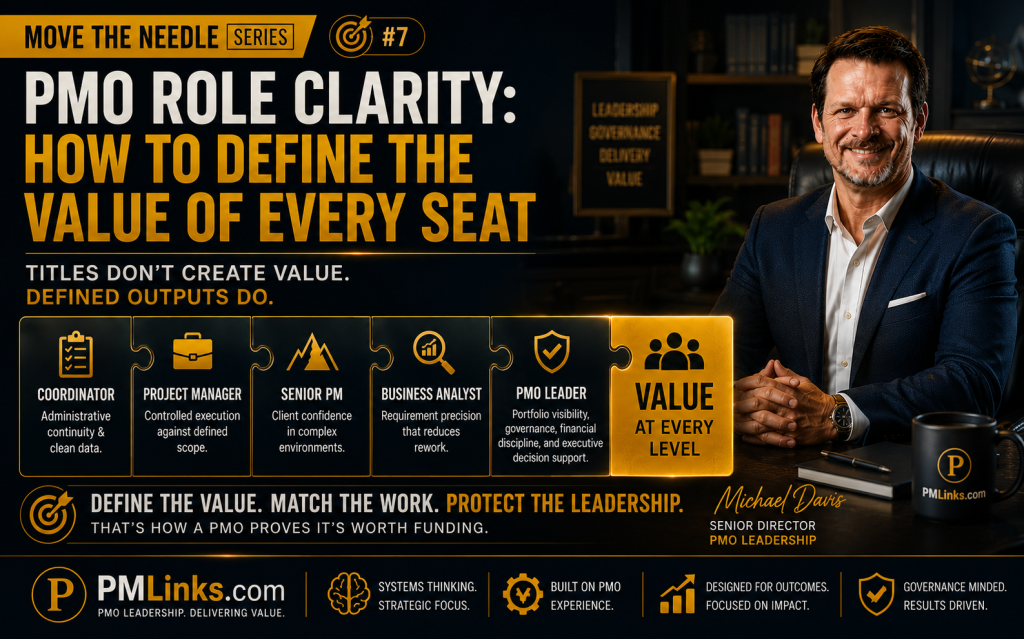
A coordinator produces administrative continuity and clean project data. A project manager produces controlled execution against a defined scope. A senior project manager produces client confidence in complex or distressed environments and absorbs ambiguity before it reaches leadership. A business analyst produces requirement precision that reduces downstream rework.
Write those statements down. Publish them. Then measure each role against the output it was funded to produce rather than against a universal delivery metric that flattens all of them.
Defined value also makes progression concrete. At one organization I led, I identified a project coordinator with clear growth potential and built a deliberate path that moved her to PM1 and then to PM2. That path existed because the difference between those seats had been defined. She held the PM2 seat after I left the company, which is the point. Development built on defined value outlasts the person who built it.
Protect the Leadership Seat
If the PMO leader is carrying a utilization target, the organization has decided that governance is optional. Say that plainly to leadership, because most of the time nobody has framed the tradeoff out loud.
Those governance outputs are not delivered in the margins between billable hours. When that seat is converted to capacity, everything it was producing quietly stops, and the decline stays invisible until an escalation reaches the executive team with no structure behind it.
What This Protects When Budget Pressure Arrives
A PMO with defined role value can answer the questions that determine whether it survives a budget cycle.
Why does this engagement need a senior seat. What are we getting for the rate difference. What happens to the portfolio if we cut two roles. What capability are we losing.
A PMO without defined role value cannot answer any of those questions with anything other than assertion. Assertion loses to a spreadsheet every time.
The organizations that get real return from a PMO are not the ones with the most project managers. They are the ones that can articulate, precisely, what each seat contributes and what disappears if that seat goes away.
The Question Worth Asking
The useful question is not how many project managers do we need.
It is what does each seat produce that none of the others can.
If you cannot answer that for every role in your PMO, including the one at the top, you are not funding a PMO. You are funding a staffing pool, and the organization will treat it accordingly.
About the Author
Michael Davis is a Senior Director level PMO transformation and delivery leadership executive. He writes about delivery leadership, portfolio governance, and PMO maturity at PMLinks.com. Connect with him on LinkedIn at linkedin.com/in/pmlinks.