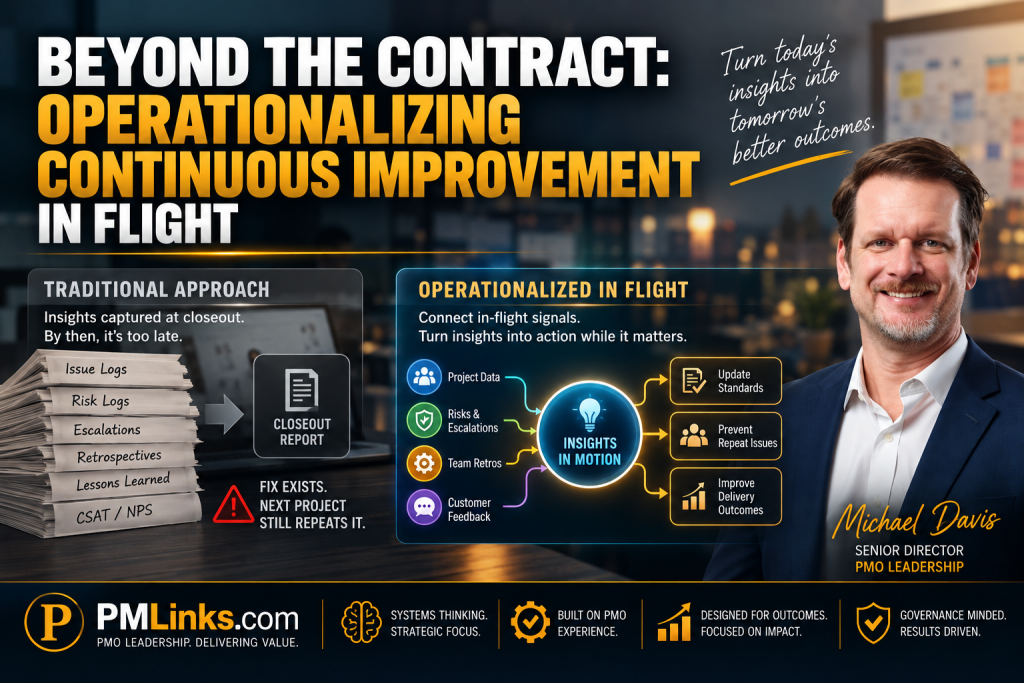
Most delivery organizations treat improvement as something that happens at closeout. By then, the projects that needed the fix have already started. Here is why the improvement cycle runs on the wrong clock, and what it takes to operationalize what you learn while the work is still in motion.
A project hits trouble in week six. The team identifies the root cause, works out a fix, and pulls the engagement back on track. The issue log gets updated. A note goes into the escalation record. Everyone agrees it belongs in the lessons learned session at closeout.
In week eight, a similar project kicks off on another team.
In week twelve, that project hits the same wall.
The fix existed. It was sitting in an issue log, waiting for a closeout meeting that was still two months away.
The Improvement Cycle Is Running on the Wrong Clock
Traditional project management teaches us to capture lessons learned at the end of a project. The intent is good. The timing is the problem.
A portfolio does not pause while one project finishes. New work is sold, scoped, and kicked off constantly. Projects overlap. By the time a lesson is formally captured at closeout, several similar engagements may already be underway, and some of them are already repeating the same mistake.
Every insight that waits for closeout is an insight the rest of the portfolio cannot use.
Continuous improvement is supposed to be continuous. In most organizations it runs on a project close cycle instead.
The Signals Are Already There
What makes this frustrating is that the evidence already exists while the work is in progress. It is just spread across the organization in places nobody reads together.
In-flight issue logs show what is breaking right now. Risk logs show what the team expects to break, and which mitigations are actually working. Escalation boards show what got serious enough to reach leadership. Agile retrospectives capture what a team learned from the sprint that just ended. Traditional lessons learned sessions add reflection after the work is complete. Inbound CSAT and NPS feedback shows how all of it looked from the customer’s side.
Those are only a few of the sources. Most organizations have far more contributing signals than they realize, and the real value comes from connecting them rather than reading any one of them alone.
These signals are not all negative. A risk that never materialized because of a smart mitigation is a signal. A sprint that ran clean is a signal. A customer who scored the engagement a ten is a signal. The things that went well need to be repeated on purpose, with the same care the organization puts into preventing what went wrong.
Why the Signals Never Become Change
I have built improvement systems at three organizations, and the same failure points show up regardless of industry, company size, or delivery methodology.
Improvement is treated as a phase instead of a flow. When learning is scheduled for closeout, it arrives too late to help anyone else in the portfolio. The organization gets historical insight when it needed operational insight.
The signals are siloed by artifact and by owner. The PM owns the issue log. The delivery lead owns the risk log. Leadership sees the escalations. Customer success sees the survey scores. Each source tells part of the story, and no one is responsible for connecting them, so the pattern stays invisible even though all the evidence exists.
Findings get captured as documents, not changes. A retro produces a slide. A closeout produces a report. The template, the SOP, the intake checklist, and the estimating model stay exactly the same. A finding that does not change a standard is only a record.
Findings land at the wrong level. Some improvements belong to one team. Some belong to a department. Some need a corporate decision. When everything goes into one bucket, organizational problems get treated as team-level fixes, and team-level details create noise for leadership. Either way, the finding never reaches the people with authority to act on it.
What Connecting the Data Actually Revealed
Early in my career I built a governed improvement process where every finding was categorized at the team, department, or corporate level and routed accordingly. A cross-functional committee with executive participation reviewed what came in and decided what needed corrective action and what should become best practice. Findings about good outcomes and bad ones were both acted on.
Years later, in the PMO I led, I rebuilt that concept with modern tooling and widened what it drew from. Escalation history, lessons learned, and delivery data were connected so patterns across the whole portfolio could be seen.
The most frequent recurring issue was not project execution. It was ambiguity in the statement of work. The problem was being created before a project ever reached delivery, and no amount of PM effort downstream could fully fix it. That finding redirected improvement work upstream into pre-sales scoping and SOW alignment, and the broader program contributed to 10 to 15 percent gains in forecast accuracy and delivery efficiency.
The bigger shift was timing. Newly sold projects were screened against escalation history and prior findings before kickoff, so relevant risks and proven mitigations reached the project manager at the start of the work instead of after the damage was done. What one project learned became protection for the next one without waiting for anyone to close out.
What “Operationalized” Actually Means
An improvement is operationalized when it no longer depends on someone remembering it, and when it reaches the work while that work can still benefit.
That means an issue resolved on one project on Tuesday can change the playbook for a project kicking off on Thursday. A recurring escalation theme becomes a prevention step built into intake, planning, or review. A mitigation that keeps working becomes a standard response. A practice that keeps producing strong customer feedback becomes the default for every similar engagement.
It also means someone confirms the change actually took hold. A standard that exists on paper but not in practice is just another document. The real test comes later: does the problem stop coming back, and does the value the change promised actually show up? Until both answers are yes, the lesson has been recorded. It has not been learned.
Why This Is Solvable Now
For most of my career, connecting signals across an organization required a person to read everything, remember everything, and recognize the pattern in time to matter. That does not scale, and it walks out the door when that person leaves.
AI changes that equation, but only if it is applied with discipline. A general chatbot pointed at a pile of documents will produce interesting observations. It will not produce consistent, governed output that an organization can build standards on. The approach has to be deterministic, so the same evidence produces the same conclusion every time.
That is the problem I set out to solve with a capability I call Pinny. It pinpoints the areas that need to be resolved and the practices worth repeating, then confirms the improvements actually held, drawing on in-flight and historical signals across an organization’s ecosystem while projects are still in motion. It sits inside a broader AI ecosystem, works across the major AI platforms, and scales from a small business to a large enterprise. It is the fourth generation of a system I have been building for more than a decade.
The Customer Is Both the Input and the Outcome
Customers never see your issue logs or your retro notes. They see whether the same problems keep happening to them.
Their feedback is one of the most valuable in-flight signals an organization has, and it is also the clearest measure of whether improvement is working. An organization that operationalizes what it learns delivers a consistent experience. The customer’s fifteenth engagement is as reliable as the first, regardless of which team shows up. That consistency drives repeat business, and it moves CSAT and NPS in a way no survey campaign can. I wrote about that connection in more depth in Beyond the Contract: What Actually Drives CSAT and NPS in Delivery Organizations.
The Question Worth Asking
Most organizations would say they have a continuous improvement process. Fewer can say how long it takes for something learned on one project to reach the next one.
So here is the question worth taking back to your leadership team: if a project on your portfolio solved a problem this morning, when would the project kicking off next week find out?
If the honest answer is at closeout, the improvement cycle is running on the wrong clock.
About the Author
Michael Davis is a Senior Director level PMO transformation and delivery leadership executive who builds PMOs from early-stage delivery operations into strategic advisory functions. His work spans portfolio governance, escalation management, AI-enabled delivery intelligence, and continuous improvement across IT services, manufacturing, energy, and consulting. He designs and builds AI ecosystems for delivery organizations, both hands-on and by leading development teams through implementation. He is the founder of PMLinks.com. Connect with him on LinkedIn.