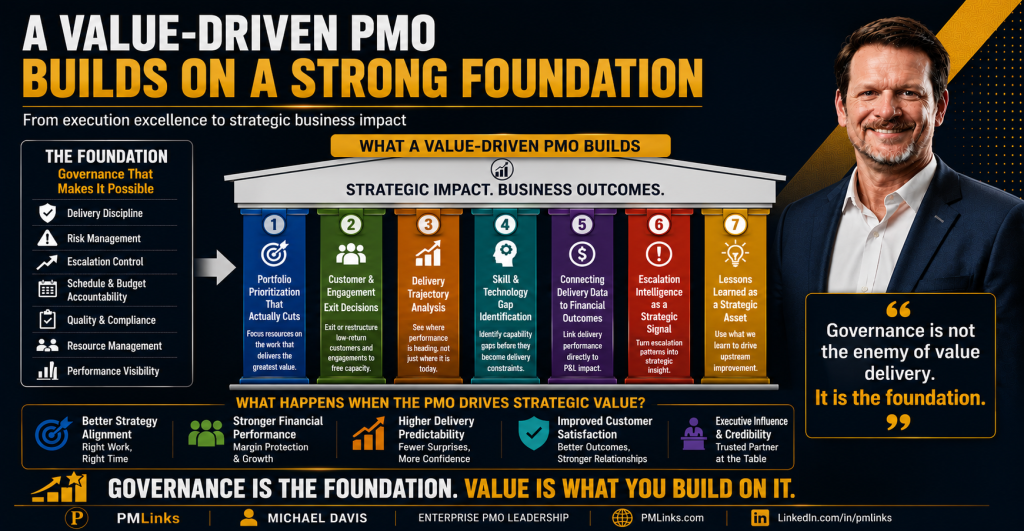
Governance is not the enemy of value delivery. It is the foundation. Here is what you build on top of it.
PMO leaders are being asked to do something bigger than the function was originally designed for.
The conversation is happening everywhere right now. Boards want to see strategic contribution. Executive teams want the PMO at the table when business decisions are being made, not just when projects need to be tracked. The phrase value-driven PMO is showing up in job descriptions, conference agendas, and LinkedIn feeds at a pace that suggests the industry has made up its mind about where this is going.
The direction is right. A PMO that only governs is leaving real organizational value on the table. The problem is that saying your PMO is value-driven and knowing what that actually requires are two very different things. A lot of the conversation happening right now is heavy on the aspiration and light on the operational reality.
So let’s talk about the operational reality.
First, the thing that needs to be said clearly: governance does not go away in a value-driven PMO. Delivery discipline, risk management, escalation control, schedule and budget accountability, these are not relics of an older model. They are the foundation that makes everything else possible. A PMO that cannot reliably execute does not get to drive strategic value. You cannot skip the foundation because the conversation has moved on. You build on top of it.
What changes is the ceiling. A value-driven PMO expands what it is accountable for beyond execution and into outcomes. It stops asking only whether projects are on track and starts asking whether the right projects are running, whether delivery performance is connecting to financial results, and whether the organization is learning from what it delivers. That expanded accountability is what earns the PMO a seat in conversations it currently does not have.
Here is what that actually looks like in practice.
Portfolio Prioritization That Actually Cuts
Most PMOs rank projects. Fewer have the organizational standing to do anything meaningful with that ranking. A value-driven PMO does not just produce a priority list. It brings forward the business case for actively stopping or deprioritizing work that is consuming resources without producing proportional return. That means giving leadership visibility into which initiatives are tracking toward their original value assumptions and which ones are not, and creating the governance forum where that conversation can happen before the loss compounds. Prioritization without the authority to act on it is just a spreadsheet.
Customer and Engagement Exit Decisions
Not every customer or engagement is worth keeping at current cost. Some consume disproportionate delivery capacity, generate elevated escalation volume, and return margins that do not justify the organizational weight they carry. A PMO with real portfolio intelligence can surface that picture clearly. Which customers are generating the most issues relative to revenue? Where is delivery effort concentrated in ways that are crowding out higher value work? That analysis gives leadership what they need to have a conversation most organizations avoid until the damage is already done. Exiting the right customers or restructuring the right engagements frees capacity for work that actually moves the business forward.
Delivery Trajectory Analysis
A PMO contributing to strategic outcomes needs to see further than current project status. Trajectory analysis means looking at where delivery performance is trending, not just where it sits today. Are cycle times improving or lengthening? Are certain engagement types or customer segments consistently underperforming against original estimates? Are resource constraints accumulating in ways that will create bottlenecks three months from now? That forward view is what converts the PMO from a reporting function into a planning partner. Status reporting tells you where you are. Trajectory analysis tells you where you are heading.
Skill and Technology Gap Identification
The delivery landscape is changing faster than most organizations are tracking. A PMO that is paying attention to how work is getting done, where delivery is slowing down, and what capabilities are missing is in a unique position to flag what the organization needs to invest in before it becomes a problem. That might be a methodology gap, a tooling deficit, an AI capability the team has not built yet, or a certification need that keeps surfacing in project post-mortems. Surfacing those patterns and bringing them forward as a strategic input to talent and technology planning is PMO work. Most PMOs are not doing it.
Connecting Delivery Data to Financial Outcomes
If the PMO is reporting on project health but the CFO is looking at gross profit and margin trajectory, those two conversations are not connected yet. A value-driven PMO builds that bridge. That means understanding how delivery performance translates into financial outcomes, where margin erosion is happening and why, how forecast accuracy at the project level rolls up to revenue predictability at the portfolio level, and what the financial implications are of delivery decisions being made in real time. When PMO reporting speaks the language of the P&L, it earns a seat in conversations it currently does not have.
Escalation Intelligence as a Strategic Signal
Escalations are not just operational noise to manage. They are data. A PMO that captures escalation patterns over time, by customer, by engagement type, by delivery team, by project phase, starts to see things that individual project managers cannot. Which customers escalate at a rate that signals a relationship problem rather than a delivery problem? Which engagement types consistently generate issues at the same phase? Where are the same root causes showing up across unrelated projects? That pattern recognition is strategic intelligence. It tells leadership where the structural problems are before they show up as another difficult quarter.
Lessons Learned as a Strategic Planning Input
Most organizations collect lessons learned. Far fewer use them for anything. A PMO serious about contributing to business value treats the lessons learned repository as a living strategic asset, not a project archive. When the same issues surface repeatedly across the portfolio, that is a signal worth acting on. When SOW ambiguity keeps appearing as a root cause of scope disputes and margin erosion, that finding should be driving a conversation about pre-sales process, contract language, and estimation discipline. When a category of risk keeps showing up in post-mortems, that pattern belongs in front of leadership as a structural problem to solve. The PMO that connects institutional learning to upstream process improvement and strategic planning is delivering value that no dashboard can replicate.
The Shift Is Real. The Work Is Harder Than the Label.
PMO leaders who are genuinely making this shift are not doing it by updating a title or adopting new terminology. They are doing it by understanding what value means inside their specific organization. What are the company’s goals? What targets is leadership trying to hit? What is the PMO currently measuring that does not connect to any of those things? What would need to change for it to connect?
Governance got the PMO to where it is. Expanded accountability, strategic contribution, and a direct line to business outcomes is what gets it to where the conversation says it should be going.
The leaders making that happen are not the ones talking about the shift. They are the ones doing the work to make it real.
About the Author
Michael Davis is a Senior Director level PMO transformation and delivery leadership executive. He writes about delivery leadership, portfolio governance, and PMO maturity at PMLinks.com. Connect with him on LinkedIn.