Introduction
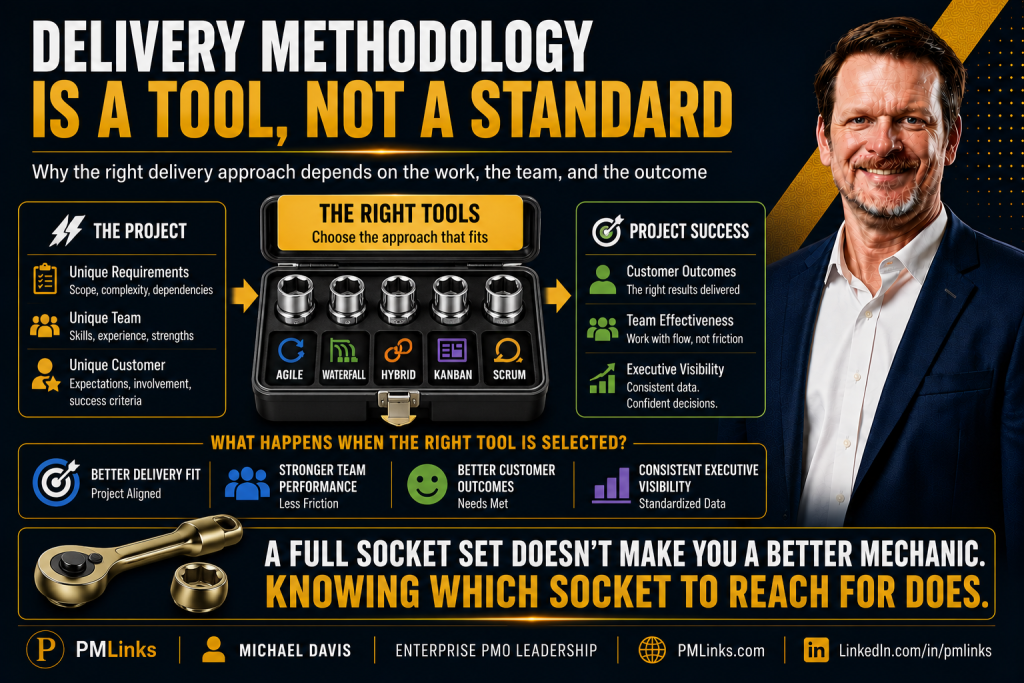
Imagine a PMO leader walking into a garage, opening a toolbox, and pulling out a ten millimeter socket before he even knows the size of the bolt.
That is what happens when a PMO standardizes on a single delivery methodology before anyone has looked at what actually needs to be delivered.
It is one of the more common governance mistakes in PMO leadership, and it tends to go unexamined for a long time because it looks like a decision, not a gap. The methodology is documented. The team is trained. The process is consistent. What could be wrong?
Quite a bit, as it turns out.
The Question That Should Come First
Before any conversation about methodology, three questions need honest answers.
What is being delivered? Not in the abstract sense of “a system” or “a platform” but in the specific sense of what the customer needs to be able to do when this engagement is over that they cannot do right now.
Who is delivering it? The team’s strengths, experience, and working style matter. A methodology that does not fit the team creates friction that shows up in your schedule and your margin before it ever shows up in a status report.
What does success actually look like for the customer? Delivering on time and on budget against a scope that missed the point is still a failure. The customer did not need the system. They needed the outcome the system was supposed to enable.
Methodology answers to those three questions. It does not replace them.
When a PMO leader selects the methodology first, those questions often never get asked at all.
The Intake Gap
The right place to make the methodology decision is during intake and initiation, at the project level, after the work has been examined and understood.
What does the scope look like? Is it well-defined and unlikely to shift, or is it expected to evolve as the engagement progresses? Is the customer able to participate in iterative review cycles, or do they need a clear deliverable at a defined point in time? What are the dependency structures? What does the risk profile look like?
Those questions produce a methodology recommendation. They do not presuppose one.
A PMO that skips this conversation and defaults to a standard methodology is not saving time. It is borrowing time from later in the engagement when the mismatch between the delivery model and the actual work starts creating rework, scope friction, and customer dissatisfaction.
What Actually Needs to Be Standardized
Here is the part that gets lost in methodology debates.
You do not need a uniform methodology across your portfolio to have consistent governance visibility. You need standardized data points.
If every project in your portfolio, regardless of whether it is running Agile, Waterfall, or a hybrid model, is reporting against the same schedule health indicators, the same cost and margin data, and the same milestone and risk structure, then your portfolio is governable. You can forecast. You can identify risk. You can make resourcing decisions with confidence.
The methodology is the delivery motion. The data is what leadership actually needs to see.
Conflating those two things is where the mandate problem starts. A PMO leader who mandates a single methodology because it makes reporting easier is solving for their own visibility at the expense of delivery fit. The right solution is to build a reporting framework that accommodates multiple delivery motions while surfacing consistent data across all of them.
That is a harder infrastructure problem to solve than picking one methodology and enforcing it. It is also the right problem to solve.
A Fair Acknowledgment for PMOs That Are Just Starting
Not every PMO has the runway to build a fully methodology-flexible governance model from day one.
When you are standing up a PMO from scratch, you are often doing it inside a live operation with active projects, limited resources, and leadership that wants results before the infrastructure is finished. That is the reality. Pretending otherwise does not help anyone.
In that environment, landing on a primary methodology is a reasonable and defensible decision. The key is that the decision should be informed. Before you select the methodology, spend enough time understanding the portfolio to know what the majority of the work looks like. What kinds of engagements are most common? What does the team know how to do well? What does your customer base expect from a delivery model?
That research gives you a foundation for the first methodology call that is grounded in something real rather than personal preference or organizational habit.
The analogy holds here too. You pick the socket that fits the most common bolt in the box. You get the work moving. But you know from day one that you are building toward a full socket set, because not every bolt you will ever see is the same size.
The PMO that starts with one methodology and plans to expand is making a pragmatic decision under real constraints. The PMO that starts with one methodology and stops there is making a mistake it may not recognize for years.
The Distinction That Defines the Leader
What separates a methodology mandate from a pragmatic starting point is not the methodology itself. It is whether the leader understands why they chose it and what comes next.
A leader who says we are starting with Agile because the majority of our current portfolio is iterative, our team has strong Scrum experience, and our primary customer segment can participate in sprint reviews is making an informed call. They know what they are optimizing for and what they are not yet equipped to handle.
A leader who says we are an Agile shop because that is how we do things here has stopped asking the questions that actually matter.
The methodology is never the point. The point is whether the customer walked away able to do what they needed to do, whether leadership had clear visibility into cost and schedule throughout, and whether the team was set up to deliver rather than forced to perform.
A full socket set does not make you a better mechanic. Knowing which socket to reach for does.
Michael Davis writes about delivery leadership, PMO transformation, and the operational patterns that separate high-performing delivery organizations from the ones perpetually fighting fires. Connect with him on LinkedIn or explore more at PMLinks.com.