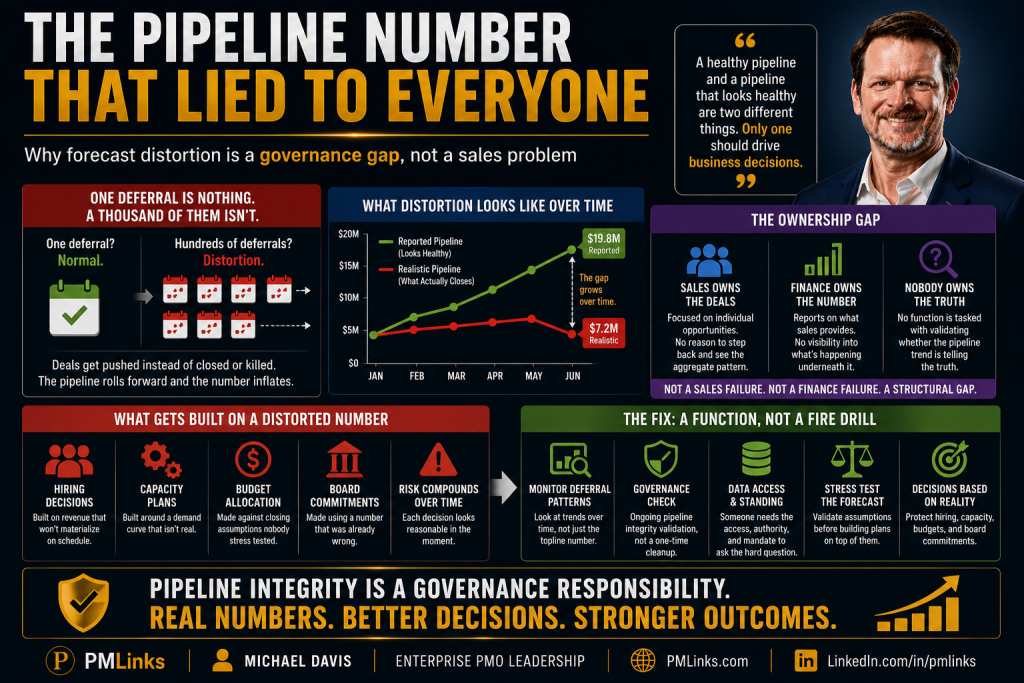
Why forecast distortion is a governance gap, not a sales problem
A leadership team approves three new hires based on next quarter’s pipeline forecast.
Six weeks later, half that pipeline is gone. Not because deals were lost. Because they were never really there in the way the number suggested.
By then the hires are already made. The capacity plan is already built around them. The board update already went out with a number that felt solid at the time.
Nobody lied. Nobody manipulated anything. The pipeline just did what pipelines do when nobody is watching the aggregate pattern instead of the individual deals.
One Deferral Is Nothing. A Thousand Of Them Is a Different Story.
A client asks for another month before signing. The opportunity gets pushed. That is a completely normal, reasonable, one-time decision. Nobody should flag it. On its own, it means nothing.
But pipelines are not built from one deferral. They are built from hundreds of them, month over month, deal after deal. When enough opportunities get pushed forward instead of closed or killed, the pipeline stops shrinking the way it should. It just rolls. The forward number keeps climbing because closed and abandoned deals are leaving at a much slower rate than new ones are entering.
From the outside, the pipeline looks healthy. Growing, even. Nobody built a way to see that the growth is coming from deals that have been rolling for four, five, six months without actually moving toward a decision.
The Ownership Gap Behind the Distortion
Here is the part that rarely gets said out loud. Sales owns the pipeline because sales owns the deals. Finance owns the number because finance reports on it. Nobody owns whether the aggregate trend is telling the truth.
That is not a sales failure or a finance failure. It is a structural gap. The people closest to individual opportunities have no reason to step back and ask what the pattern looks like at scale. The people reporting the topline number are working from what sales gives them. Nobody is positioned to stress test the forecast against what is actually happening underneath it.
Without that function, distortion compounds quietly for months before anyone notices.
What the Data Showed When Someone Finally Looked
At one organization I led, leadership handed my team a monthly revenue close target tied directly to the pipeline. Before committing to it, I went into the raw data myself to check whether the pipeline could actually support that number.
It could not. A systemic pattern of opportunity deferrals was rolling the same deals forward month after month, inflating the forward pipeline well beyond what was realistically going to close. I brought that finding directly to the COO and CEO. It was not a comfortable conversation. It triggered a full leadership-level revamp of how the pipeline was forecasted and reported.
That finding did not just change a target. It protected every decision that was about to get built on top of a number that was not real.
What Actually Gets Built on a Distorted Number
This is the part that makes pipeline distortion expensive instead of just embarrassing.
Hiring decisions get made against forecasted revenue that will not materialize on schedule. Capacity plans get built around a demand curve that is steeper on paper than it is in reality. Budget gets allocated against closing assumptions nobody stress tested. Board commitments get made using a number that was already quietly wrong when it went into the deck.
None of these decisions look reckless in the moment. Each one is a reasonable call made on the information available. The problem is that the information was distorted before it ever reached the people making the call.
The Fix Is a Function, Not a Fire Drill
The answer is not a one time pipeline cleanup. Organizations do those and the same pattern rebuilds itself within a few quarters because nothing structural changed.
What actually closes the gap is treating pipeline integrity as an ongoing governance check, not a sales report you take at face value. Someone needs to be looking at deferral patterns over time, not just the topline forecast number. Someone needs the standing and the data access to ask an uncomfortable question before leadership builds a plan on top of an answer nobody verified.
That is not about distrusting sales. It is about recognizing that a healthy pipeline and a pipeline that looks healthy are two different things, and only one of them should be driving hiring and capacity decisions.
About the Author
Michael Davis is a Senior Director level PMO transformation and delivery leadership executive. He writes about delivery leadership, portfolio governance, and PMO maturity at PMLinks.com. Connect with him on LinkedIn at linkedin.com/in/pmlinks.