Every delivery organization has a version of this story. A project manager walks into a kickoff meeting prepared, professional, and ready to make a strong first impression. The customer walks in expecting one thing. The PM is set up to deliver something slightly different. The gap is not large enough to stop the meeting but large enough to plant a seed of doubt.
That seed is expensive.
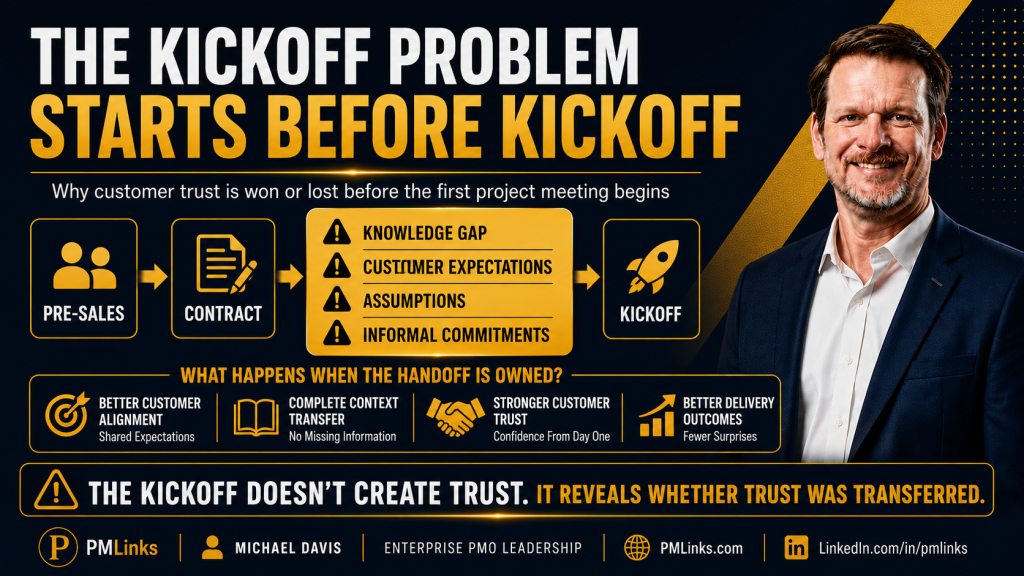
The kickoff meeting is where customer trust is either built or begins to erode. What most delivery leaders miss is that by the time the kickoff happens, the outcome is largely determined by decisions that were made weeks earlier, during the handoff from pre-sales to delivery.
The Handoff Is Where It Starts
When a contract is signed, something transitions. But in most organizations, what actually transfers is documentation. A signed SOW. A contract file. Maybe an email thread if someone remembered to forward it.
What does not transfer is context.
The pre-sales team knows things that are not in the contract. They know what the customer said they were trying to solve in the first discovery call. They know which stakeholder had reservations. They know what was negotiated informally before the language was finalized. They know what the customer thinks they bought versus what the contract actually says.
None of that lives in the SOW. And if no one carries it across the handoff, the PM inherits a document and a gap.
Treating the pre-sales to delivery transition as a knowledge transfer rather than a file transfer is a leadership design decision. It requires a standard, not good intentions.
What a PM Actually Needs Before Kickoff
A PM preparing for a strong kickoff needs more than the contract. They need to work through a specific set of questions before the customer is ever in the room.
What is the customer actually trying to accomplish? Not what the contract says will be delivered. What business outcome were they buying toward? These are sometimes the same thing. Often they are not entirely.
What assumptions are embedded in the SOW? Every contract has them. Assumptions about customer readiness, about access to systems or stakeholders, about timelines that were agreed to before anyone fully understood the complexity of the environment. A PM who surfaces these before kickoff can address them deliberately. A PM who discovers them during delivery is managing a dispute.
Where is the scope language ambiguous? Not every SOW is written with the precision it should be. When language is vague, both sides fill the gap with their own interpretation. The kickoff is the last moment to align those interpretations before work begins.
What does the customer expect from the kickoff itself? Some customers want to hear a detailed project plan. Others want to know their team is in good hands and that someone has a grip on what they signed up for. Reading that expectation wrong sets the wrong tone from the first meeting.
What are the boundaries that need to be established now? Change control process. Escalation path. Communication cadence. Decision rights. These are not administrative details. They are the governance architecture of the engagement, and the kickoff is the right moment to make them explicit before they are ever needed.
At one organization I led, we built a formal pre-kickoff prep standard that required every PM to document their answers to these questions before the kickoff was scheduled. Not as a checklist exercise. As a flag-raising mechanism. If a PM could not answer the questions with confidence from what they had been given, that was a signal that the handoff was incomplete and the gap needed to be closed before the customer was in the room.
That standard changed the quality of our kickoffs. More importantly it changed what we asked of the pre-sales team during the transition.
What the Kickoff Itself Needs to Cover
A well-prepared PM walks into a kickoff with a clear agenda that accomplishes several things simultaneously.
It confirms shared understanding of what is being delivered and why. Not just scope items. The business outcome the customer expects from the engagement.
It surfaces and resolves assumptions before they harden into disputes. If the SOW assumed customer resources would be available at project start and that may not be true, the kickoff is where you say it out loud and get clarity.
It establishes governance expectations. Change control, escalation, communication, decision rights. These land better at kickoff than mid-project when emotions are already running.
It sets the customer’s expectations for what comes next. What they will see from the team in the first week. When they will hear from their PM. What a healthy engagement looks like going forward.
And when necessary, it resets expectations that were set incorrectly during the sales process. That is a harder conversation. But a PM who can have it professionally and confidently at kickoff is protecting the engagement from a much harder conversation three months in.
The Leadership Question Behind the Kickoff
Most delivery leaders think about kickoffs at the PM level. Did the PM present well. Was the customer satisfied. Did we start on the right foot.
The better question is structural. What did we give that PM to walk in with, and was it enough?
If the answer involves a contract and a file transfer, the organization has not yet made a leadership decision about kickoff quality. It has delegated that decision to whoever shows up in the room.
The kickoff is the first visible moment of delivery. What it reflects is the health of everything that happened before it.
When organizations get this right, kickoffs become a competitive differentiator. Customers leave feeling like the team has a handle on what they need, that ambiguity has been addressed rather than avoided, and that the governance structure is already in place to protect them when things get complicated.
That kind of start is recoverable from almost anything. The alternative is spending the rest of the engagement trying to recover from the kickoff itself.
Michael Davis writes about delivery leadership, PMO transformation, and the operational patterns that separate high-performing delivery organizations from the ones perpetually fighting fires. Connect with him on LinkedIn or explore more at PMLinks.com.