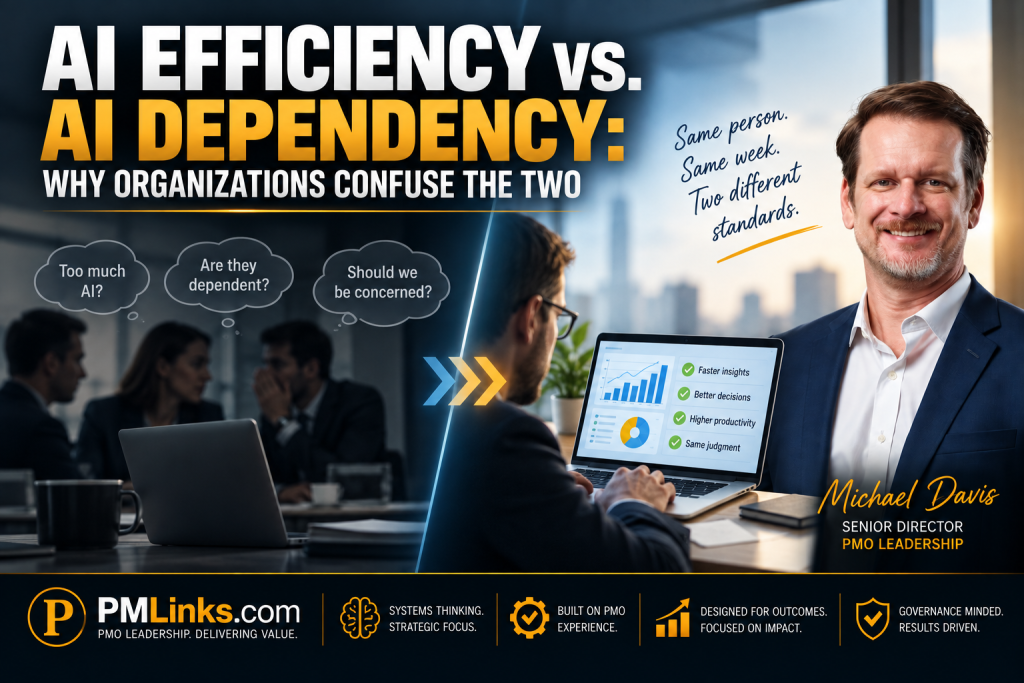
Somewhere in most organizations right now, a capable person is being quietly questioned for being good at something new.
The conversation usually happens sideways. It is rarely a comment made to someone’s face. It shows up in a meeting where the topic stops being the project or the client and becomes the people. Specifically, who on the team seems to be leaning on AI a little too much.
Nobody in that conversation can say what “too much” means. There is no threshold, no definition, and no measurement behind it. There is only a feeling, and the feeling attaches itself to whoever looks the most fluent with the tool.
The Contradiction Nobody Notices
Here is the strange part. The same people raising the concern are often the ones impressed by the output. Reporting that used to take two to three days to assemble now refreshes every couple of hours. Decisions that used to wait on a status update get made in the meeting because the data is already current and already sitting in front of everyone.
The output earns trust. The process behind it earns suspicion. Same person, same week, two different standards, and nobody connects them.
Nobody calls a carpenter overly dependent on the hammer. If someone is driving nails faster and cleaner than the person next to them, the question is not why they rely on the hammer. The question is why the rest of the room is still using a rock.
What Is Really Going On
This is not a conversation about AI. It is judgment operating without a standard. When an organization has no shared definition of responsible AI use, instinct fills the gap. Instinct lands hardest on the people furthest ahead, not because they are doing anything wrong, but because they are the most visible.
The result is a quiet penalty on exactly the people the organization should be learning from. Promotions, high-stakes assignments, and the benefit of the doubt on an analysis all drift toward people who look cautious instead of people who deliver.
Efficient and Dependent Are Different Things
Dependency is a real risk, and it deserves a real definition. Efficiency means the tool accelerates your thinking. Dependency means the tool replaced it. A usable test comes down to three questions:
- Does the person verify what the tool produced against the source before acting on it?
- Can they explain the reasoning behind a decision without the tool in the room?
- Has the tool removed the administrative grind, or has it removed the judgment?
Most of the people being discussed in those side conversations pass all three. They still make the call. They still check the work. They just eliminated the days of assembly that used to sit between a question and an answer.
What a Standard Looks Like
In the PMO I led, we did not debate dependency in hallways. We measured it. Adoption was tracked by individual and by department from the day the program launched, so we knew who was using what and how usage was growing. The PMO team reached full adoption, with usage climbing 10 to 15 percent week over week.
Every AI agent cleared a formal security review before it went live. Access to the knowledge behind each agent was limited by role and business need. And the ethical guardrails were written down, not just discussed. For example, resource utilization data surfaced by the workforce planning agent was explicitly prohibited from use in workforce reduction decisions or individual performance reviews.
None of that slowed anyone down. It gave the organization a way to tell the difference between someone using a tool well and someone using it carelessly, which is the one thing a hallway opinion can never do.
The Better Question
If someone on your team is producing better output, faster, with a tool the rest of the room has not caught up to, that is not a concern to whisper about. That is a person worth pulling aside to ask one thing: how are you doing that, and can you show the rest of us?
The organizations that get this right will not be the ones with the longest AI policy document. They will be the ones that stopped confusing capability with dependency long enough to learn from their fastest people.
About the Author: Michael Davis is a Senior Director level PMO and delivery transformation executive with a career spanning IT services, manufacturing, energy, and consulting. He writes about delivery leadership, organizational maturity, and AI-enabled portfolio governance at PMLinks.com. Connect with him on LinkedIn at linkedin.com/in/pmlinks.