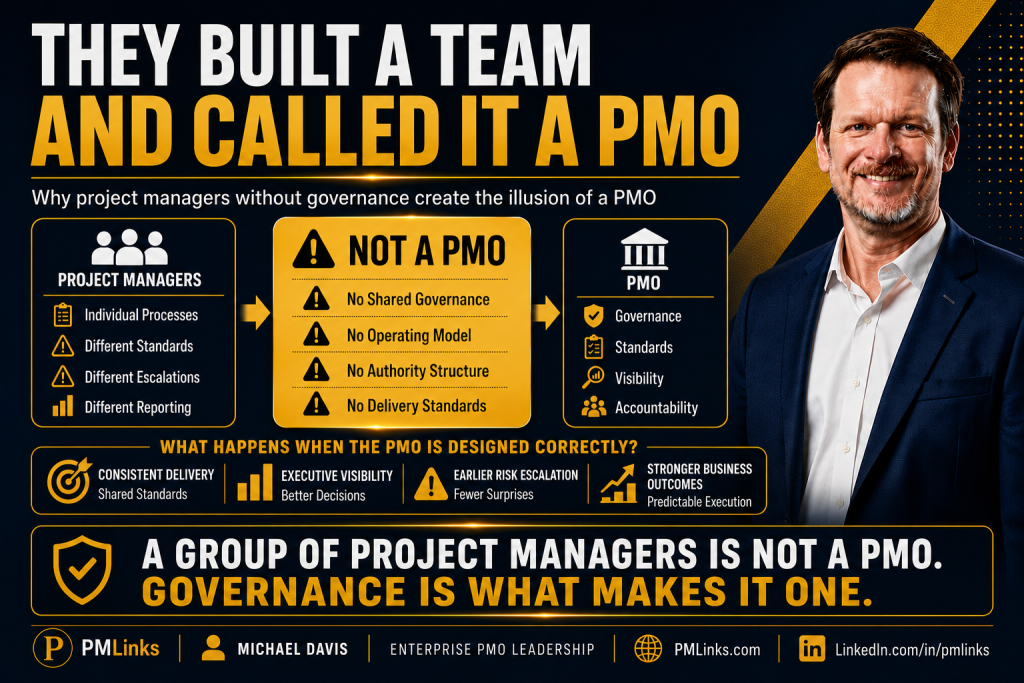
You assembled a team of project managers and called it a PMO. That’s where everything went sideways.
The distinction sounds semantic until you realize what it actually means operationally. A PMO is not a department. It’s a governance entity, a system designed to protect revenue, standardize delivery, manage risk, and ensure visibility across your entire project and portfolio landscape. Project managers operate within that system. They execute the strategy the PMO defines. But the PMO itself has to function as its own operating organism.
When you skip that step and just group project managers together, you end up with a collection of individuals doing their own thing. Some might be exceptional. Others might not even understand what a project manager actually does. You have no standards. You have no SLAs. You have no central visibility into what’s actually happening across your delivery portfolio. You haven’t built a PMO. You’ve built a team.
And it will fail under pressure.
The Pattern Behind the False Starts
Most organizations that struggle with PMO maturity follow a predictable path. First, they decide they need a PMO without actually defining what a PMO is supposed to do for their business. They don’t ask the hard question: what business problem are we solving here? What outcomes do we actually expect? They just know they need “better project management,” so they hire some people they think are project managers, put them on a team, and call it done.
Then reality hits. Projects slip. Risks surface late. Customer expectations get missed. They realize something’s broken, but they’re not sure what.
The second false start comes when they try to fix it by bringing more people on board or reorganizing the team they already have. They might acquire other companies with their own project managers and their own ideas about what project management should be. They bring everyone into the fold, still without defining what the PMO actually exists to accomplish. Now you’ve got multiple subcultures with conflicting approaches, no shared standards, and even less clarity about what success looks like.
The third false start happens when they finally realize the PMO isn’t positioned where it needs to be in the organizational hierarchy. They’ve buried it under a leader who doesn’t understand what it takes to build and stabilize it. Or they’ve made it a secondary responsibility for someone who already has a full job. The structure is wrong. The authority is fragmented. The PMO can’t actually function as a governance entity because nobody gave it the platform to do so.
And through all of this, the organization still hasn’t answered the fundamental question: why does this PMO exist, and what is it supposed to protect or enable?
What a PMO Actually Is
Think of a PMO as its own operating system. Individual project managers are the applications running on top of it. The PMO defines the standards, the governance processes, the reporting cadence, the escalation paths, the risk management approach, the resource allocation framework, the quality gates. It’s what ensures that whether your project managers’ names are Michael or Jennifer or Bill, they’re all operating in the same way, delivering to the same standards, surfacing risks through the same mechanisms, and protecting the same organizational outcomes.
That operating system doesn’t exist when you just have a team of project managers. It gets built through intentional design work upfront, before you hire the first person.
A mature PMO protects revenue by ensuring projects deliver what was promised. It protects customer expectations by making sure commitments are realistic and tracked transparently. It protects contracts by catching scope creep and change management early. It protects your organization’s ability to execute by creating visibility into capacity, capability, and risk across every active initiative. It’s the entity that says “we can’t take on that project right now because we don’t have the bandwidth” or “this is going to fail unless we address this risk now.” It’s not a scheduling function. It’s not a note-taking function. It’s a strategic lever.
The Hard Truth
You can’t retrofit purpose and governance into a structure that was built without them. You’ll spend months trying to impose standards on people who were hired without clarity on what the role actually demands. You’ll struggle to gain authority for decisions that should be non-negotiable because the PMO was never positioned as a decision-making entity in the first place. You’ll watch projects slip and risks surface late because you’re still operating like a coordinating function instead of a governing one.
At some point, you have to admit that what you built isn’t working and start over.
That means stepping back and answering the questions you should have asked at the beginning. What is the PMO supposed to accomplish? What business outcomes are we protecting? What standards do we need in place? What authority does the PMO need to function? Who should lead it? Only after you’ve answered those does hiring and structure make sense.
Recovering Without Stopping the Business
Acknowledging that your PMO needs to be rebuilt doesn’t mean you can shut everything down while you redesign it. Projects are still running. Customers still have expectations. Your team still needs to show up tomorrow and do something.
The first move in recovery is not reorganization. It’s assessment. Before you change anything, you need to understand what you actually have. Who on your team is a genuine project manager and who was hired without clarity on what the role required? What work is actively in flight and what’s the real health of it? Where are the risks no one is talking about? What do your internal stakeholders and customers actually expect from the PMO that they’re not currently getting? You can’t design a path forward without an honest picture of your current state.
The second move is defining business outcomes. Not PMO goals. Business outcomes. What does the organization need the PMO to protect or enable? Revenue? Customer retention? Contract performance? Delivery predictability? Until you can answer that in plain language, everything else you build is just structure for its own sake.
The third move, and this is where most recovery efforts fall short, is establishing a baseline operating model before you build the mature one. Your team cannot operate in a vacuum while you’re doing transformation work. They need clarity on how to work right now. That means defining a core set of standards that go into effect immediately: how projects get initiated, how status gets communicated, how risks and issues get escalated, how decisions get made. It doesn’t have to be sophisticated. It has to be consistent. A simple, shared operating model that every project manager follows gives the team stability and gives leadership visibility while the more mature structure is being built alongside it.
Think of the baseline model as the scaffold. It holds everything up while you construct the permanent structure behind it. You iterate on it. You mature it. But you never leave the team without something to operate within.
The fourth move is positioning. Recovery fails when the PMO doesn’t have the organizational authority to govern. If the PMO is still buried under the wrong leader or treated as a secondary function, the standards you just built won’t hold. Recovery requires that leadership visibly and explicitly backs the PMO’s authority to set delivery standards, require compliance, and surface issues that need executive attention. Without that, you’re just creating documents nobody follows.
What Gets Built From Here
Organizations that recover from a false start PMO do it by slowing down long enough to answer the questions they skipped the first time. They define purpose before structure. They establish a baseline before they build complexity. They position the PMO where it can actually govern. And they give it the leadership authority to hold the line.
The organizations that keep false starting are the ones that keep trying to fix the team when the problem was never the team. It was the design work that didn’t happen before the team was assembled.
The PMO is not a group of people. It’s the system those people operate within. Build the system first. Then staff it. Then mature it. In that order, every time.
Michael Davis writes about PMO transformation, delivery governance, and the organizational failures that keep good teams from doing their best work. Connect with him on LinkedIn or explore more at PMLinks.com.